NOTES:
All thick and thin planchet varieties are included together in the same population figures.
HK1001 in Gold: Two of these pieces in gold have been sold in recent times. Heritage Auctions sold one in September of 2007. It was graded NGC EF45 and sold for $63,000. A second one sold later, in NGC PF62 for just under $200,000. The January 1910 issue of the Numismatist has an advertisment on page 32 for the sale of the Erie Canal gold medal presented to General Andrew Jackson
HK1 in Copper: The American Numismatic Society in New York has an HK 1 in copper/bronze. It is the only one that I know of.
HK1 in Lead: From Charles Kirtley sale #8 lot #346 (May 28, 1985) which states: "HK 1 but struck in Lead. AU and a nicer strike than usually seen in the White Metal varieties. This is the second lead striking known to us"
HK1 bronze plated white metal: Holed and no doubt plated as a novelty sometime after striking.
HK2: The late John Ford had three of these in silver that were sold by Stacks in their May 10, 2005 sale. Joe Levine from his 58th PCAC sale lot#186 states: "This is a great rarity as well as being one of the most important historical pieces in the So-Called Dollar series. Insofar as we know, the identity of the "C.R." engraver is unknown and we can come up with no likely candidate. This is the only known medallic artifact of our semi-centennial celebration in 1826. It is considerably rarer than the Silver Erie Canal medal which consistently brings in the $1,500-$2,000 range, and, in our opinion, is more historically signifigant."
HK5 Copper: Joe Levine from his 59th PCAC sale lot#194 states: "The 1858 New York Crystal Palace Exhibition was the first World's Fair held in this country. White metal examples show up with some frequency, but the copper specimens are quite rare." These medals also show up in brass(possibly gilt) and appear to be as rare as the copper ones. Presidential Coin and Antique sold one in their June 7th, 2008 auction (lot #119) that was described as copper but looked brass.
HK7: I found three of these, all entered into my tally, and all from Presidential Coin and Antique Co. sales. One was silver, sale #40(Part 1) lot#160. Another, also evidently in silver, sale #7 lot#260(holed and edge bruised). A third was white metal, sale #31, lot#545. The white metal piece was not described as silver plated as suggested in HK. In sale #40 Joe Levine states: "Such pieces were probably given to members of the exposition police as mementos of their service. An exceptionally rare relic of the first international exposition held in the United States.".
HK7a: This piece was not listed in the first edition of HK. Although still quite rare, it does not appear to be as rare as HK7.
HK11a: In Presidential Coin & Antique Company(PCAC) sale #70 lot#456 Joe Levine stated: "This token, with it's reverse of an eagle within a circle of stars, is considerably scarcer than it's HK 11 brother. Both the obverse and the reverse of this piece were used on a George McClellen political by George Lovett(See GMcC 18654-8 and 1864-8(D). The present piece is cataloged by DeWitt/Sullivan as GMcC 1864-8(F)"
HK12 in Silver (HK12a in the 2nd edition of HK): The eight sales of HK12 in silver(HK12a in the 2nd edition) that I recorded in my tally were as follows: 1)PCAC sale 31 lot 1163 described as AU (no photo). 2)PCAC sale 48 lot 198 described as "choice Unc with attractive iridescent toning", and "this must be amongst the nicest"(with photo). 3)PCAC sale 68 lot 103 (with photo) described as "choice proof with iridescent toning from Stack's Coin Galleries sale of July 1993 #141 where it brought $1810.00". This piece could also be the same as the piece that sold in PCAC sale 48, lot 198, but comparing the photos, they are probably different. 4)PCAC sale 69 lot 120 described as "XF/AU with some scattered field marks"(with photo). 5)Rich Hartzog 12/1/80 lot 889 described as "nicely toned steel color with some minor hairlines"(photo of reverse only). 6)Johnson and Jensen sale 15/16 lot 366 described as "toned EF"(with photo). This piece was probably better than EF due to the fact that Johnson and Jensen grading was often very conservative. 7)NASCA sale of the Wayte Raymond collecton sold in June 1978, lot 3710. It was described as "XF, toned"(with photo). 8)NASCA Kessler-Spangenberger sale April 28, 1981 lot 1760. It was described as "Toned Unc, with electric green, gold and violet toning on obverse, blue and gold reverse."(with photo). Other sales that I found but did not tally are as follows: 9)Tony Swicer's sale in 1992, simply described as "Unc"(no photo). 10)PCAC 70 lot 459, this is the same piece that sold in PCAC sale 68 lot 103 - "choice proof with iridescent toning"(with photo). 11)I bought a piece off of ebay a few years ago that I would probably describe as AU.
HK12 in gilt(HK12b in the 2nd edition of HK): There were two of these that I found in gilt. The first was PCAC sale 68 lot 105. It was described as AU on a thick 5.2 mm planchet with obverse edge dent at 4:00 and a reverse edge nick at 11:00, with other small digs and nicks on the reverse. This same piece also sold in PCAC sale 70 lot 461. The second piece sold in Stacks 5/6/92 sale lot 239. It was described as Choice AU, lightly hairlined, with a small spot of verdigris on "D" in "Presidency"; and the edge was scratched. It was also struck on a 5.2 mm planchet. Copper pieces are struck on 3.9 mm planchets.
HK13 to HK15: This piece appears to come in a variety of compositions and thicknesses, with thick planchet varieties being rare. I own a silver one that tested at a specific gravity of 10.45. When Tony Swicer sold his collection in 1992 he had four silver plate HK13 pieces for sale at $30 each, but he also had a single piece for sale at $275 that he described as "13a Silver CH AU". A silver plate piece of mine that I tested had a specific gravity of approximately 8.8. HK15 is described in HK as being brass, but in a number of different sales catalogs I have found this piece described as gilt. At this point I do not know if they are all gilt, all brass, or perhaps come both ways. The single white metal piece that I recorded was from Paul Koppenhaver's 12/8/86 sale where it was described as "WM, unlisted, XF".
HK19: Joe Levine from his 54th PCAC sale lot#170 states: "Accompanying this piece is a folded, foxed and somewhat ragged period copy of an attestation signed by A. Loudon Snowden, Coiner of the Mint. "I certify that the Nevada Exposition Medals, prepared in this department, and this day delivered to Mr. G.G. Stevenson, Chairman of the Nevada States Board, are made of pure silver crushed from Nevada ores, at the Nevada Quartz Mill located in the Centennial Exhibition Grounds, and subsequently refined at the United States Mint"
HK19a: A copper piece was sold at the December 2008 Bill Weber auction held by Holabird-Kagin America in Reno Nevada. It sold for $7475. It may be unique. It was graded Proof 65 by NGC.
HK20: There are evidently two different die varieties of this medal. Joe Levine from his 64th PCAC sale lots#1384/1385 states: "Struck from the relatively scarce obverse die #1 which has over 40 thin rays emanating from the glory of stars at the top and also has the 1 in 1876 partially over the T in THESE".........Lot #1385: "Struck from the much more common obverse die #2 which has 27 relatively thick rays and with the 1 in the date to the right of the T in THESE"
HK20 in White Metal(HK22a in the 2nd edition of HK): Three of the four recorded sales were exactly the same piece that was sold 3 different times by Presidential Coin and Antique. With regard to this piece, Joe Levine from his 40th(Part 1) PCAC sale lot#166 states: "is pedigreed to the personal collection of Charles Barber from whose family we purchased it. One of only three known examples in white metal. Undoubtedly a trial striking"
HK23 to HK26: There are two die varieties. The basic difference is that one variety has a pointed 6 in the dates on both obverse and reverse, the other a rounded 6 both obverse and reverse. I have not seen any pieces muled with pointed sixes on one side and rounded sixes on the other, although they may exist. The silver pieces I have seen(and I have not seen many) all had pointed sixes. The Bronze/Copper(HK24, HK25) pieces come both ways, and I am not sure which is the rarer. The white metal pieces also come with either pointed or rounded sixes, with the rounded six pieces appearing to be rarer. Personally as a collector I do not make much of a distinction between bronze and copper. Once a nice patina has formed, it is difficult to tell anyway. In HK, the four varieties are silver(HK23), bronze(HK24), copper(HK25), and white metal(HK26). The Gilt Bronze piece comes from Charles Kirtley sale 138 lot#AA02 described as Choice AU-55. I know a silver piece from NASCA sale June 6, 1978 lot#3907, another from the Ostheimer sale, and a third from Presidential Coin and Antique Company(PCAC) sale June 7, 2008 lot#128
HK27 to HK29: Varieties exist with and without a star in between "Therof" and "Proclaim". It appears that the star variety in white metal is by far the most common, with perhaps a bit less than half being found holed. White metal pieces without a star appear to be quite rare; however it is possible that some of my tallies of white metal pieces with a star were in fact no star varieties, but probably not that many. As far as copper/bronze pieces go, my tally seems to suggest that the star and no star varieties are of similar rarity, but evidence elsewhere may suggest otherwise. I do not know if silver and brass pieces exist with and without a star.
HK30 in Silver: Three sales that I know of were two sales in Stacks auction May 6th 1992 lot#139 and lot#140, and Presidential Coin and Antique sale #73 lot#213:
HK34: Joe Levine from his 58th PCAC sale lot#192 states: "HK’s use of "extremely rare", while much overdone, is entirely accurate in this instance. This is the only example of this piece we have ever handled." The sole bronze piece is from the April 28th 1981 NASCA sale, lot#4015 where it was described as "Unc.-63 to 65".
HK39 gilt/Brass: Found one piece described as gilt from the Ostheimer sale in August 2010. Know of one brass example from Stacks November 2019 sale lot #20646. Brass and gilt pieces can be easily mistaken for each other.
HK42 to HK45: This piece is confusing if you compare the first edition of HK with the second edition. The newer 2nd edition HK book pictures the same piece as Baker 394(page 184) in Rulau/Fuld’s "Medallic Portraits Of Washington 2nd Edition". However, the description in the 1st edition HK book describes a different reverse (and does not show a picture). Certainly it is possible that the authors of the 1st edition HK book mistakenly described their HK42-HK45 as having the same reverse as HK23, when if fact they meant to describe it as having the same reverse as HK48, but the fact of the matter is that HK42-HK45 does exist (at least in copper/bronze) as described in the 1st edition of HK. Joe Levine of PCAC actually sold an HK43 in his sale #25 lot #1314 exactly as described in the 1st edition of HK. Paul Van Sant also sold an HK43 in his August 1997 fixed price list exactly as it is described in the 1st HK edition. A third was probably(the description was not elaborated on to be absolutely sure) sold by Charles Kirtley #160 lot#MO55. Also note that all three of these HK43s as described in the first edition were looped(possibly clamped on loops). Also, possibly two out of three, or even all three could in fact be the exact same piece. If you are looking at my web page for the 1st HK edition, the tallies represent what I found for the piece as described in the first edition of HK. If you are looking at my web page for the second HK edition, my tallies represent what I found for the other piece as pictured in Rulau/Fuld’s "Medallic Portraits of Washington". This second piece is obviously more common. The sole Baker394 piece described as Copper Nickel was from PCA #58 lot#193.
HK46c: One of these in silver sold in NASCA sale April 28, 1981 lot#4019
HK47 and HK47a: The first edition of HK describes HK47 as being the Reverse of HK 60 combined with the Reverse of HK27. The second edition describes it as being the Reverse of HK60 combined with THEIR Obverse of HK42(look at note above for even more confusion). I am guessing that HK47 as described in the first edition of HK is in error as I have never come across an HK47 as described in the first edition. I have come across HK47 as described in the second edition, so I am going to assume that the second edition is correct, and treat HK47 in the first edition as if it is the piece described in the second edition of HK. So the tally you are looking at in the first edition is for the piece described in the second edition. One of the bronze pieces tallied was from NASCA auction 4/28/81 lot#4022. The brass piece tallied was from NASCA auction 6/6/78 lot#3959.
HK52 in silver plate: Stacks sold one of these that looked to them as if it were possibly silver plate in their February 2015 Americana auction lot#161. It was in an NGC holder designated as MS-64 Brown. Tony Swicer also had one for sale in 1992 that was described as HK54 Silver plate. Also Presidential Coin and Antique Co sold one in sale #56 lot#1136 described as "HK54, But silver plated Washington-Liberty Seated Dollar, 1876. Baker 405. Choice AU".
HK56 in Silver: Two of these in silver sold at NASCA sale April 28, 1981 lot#4027 and lot#4030
HK60 in Silver: Tony Swicer had this silver piece for sale in his April 1992 fixed price list, asking $300. In the same sale he also had HK27, HK33, and HK48, also all in silver, and also all priced at $300 each. Interestingly Charles Kirtley sold what appears to be the exact same pieces in his mail bid sale #84 June 9, 1992, all with minimum bids of $300 each, so it appears that they may not have sold in Tony Swicer's sale, so were given to Charles Kirtley to sell two months later. I remember buying a few pieces from Tony's April 1992 list, but unfortunately not any of those rare silver ones. Boy do I kick myself now!
HK69: There are two die varieties. The more common one is where the T of TO is directly below P of Park. On the more scarce one the T is between the P and A of Park. Both varieties are listed here together.
HK70b and HK70c: Strictly speaking, using the first edition of HK as a guide, this piece might not qualify for inclusion as a so called dollar, as it does not commemorate anything except George Washington. Both sides are what I would call "neutral" in nature, neither causing the piece to be included or excluded. It commemorates George Washington, but purely presidential pieces were not included in the 1st HK edition. My guess is that the authors of the first edition of HK would not have put this piece in their book had they had possession of it. I suppose one could make a rule that if a new piece comes to light that mules two sides of two different so called dollars, then that piece could also be included as a so called dollar, even if it does do commemorate anything; but that is not a criteria that I have used, and it does not appear to be a criteria that the original authors used. This piece is probably quite rare. I do not think it is listed anywhere in Rulau/Fuld. I did not record it’s rarity in my tally.
HK72 Brass and gilt: HK states that this piece exists in Brass, while Rulau/Fuld (Baker404) says it exists in gilt. Three separate auctioneers, Johnson and Jensen, Charles Kirtley, and Presidential Coin and Antique described pieces they were selling as being gilt copper. In fact, Presidential Coin and Antique auction #59 lot #838 describes this piece as "HK72 Same as above, but gilt (unlisted thus). "In other auction catalogs this piece is described as Brass, so in fact maybe it exists both ways. Gilt and brass pieces are of course easily confused with each other. In July of 2019 I did a specific gravity test on one of these that appeared to show copper showing through on one of the fields. Sure enough, the specific gravity was 8.89, which indicates pure, or at least nearly pure copper.
HK72c: The sole silver piece recorded here was from the 4/28//81 NASCA sale lot#4028 where it was described as Unc.-63. The sole brass piece was from the 6/6/78 NASCA sale lot#3960, and had an incused number 1 next to the small "No" at the bottom on the reverse. There were four other pieces from this same sale with different obverses, but the same reverse and the same incused number 1, all thought to have been part of a unique presentation set. All five pieces were in Unc condition with reeded edges.
HK73: There is no picture of this piece in either HK edition. A picture can be found in the May 6, 1992 Stacks sale of the Gilbert Steinberg collection lot# 290. The American Numismatic Society in New York evidently has one in copper.
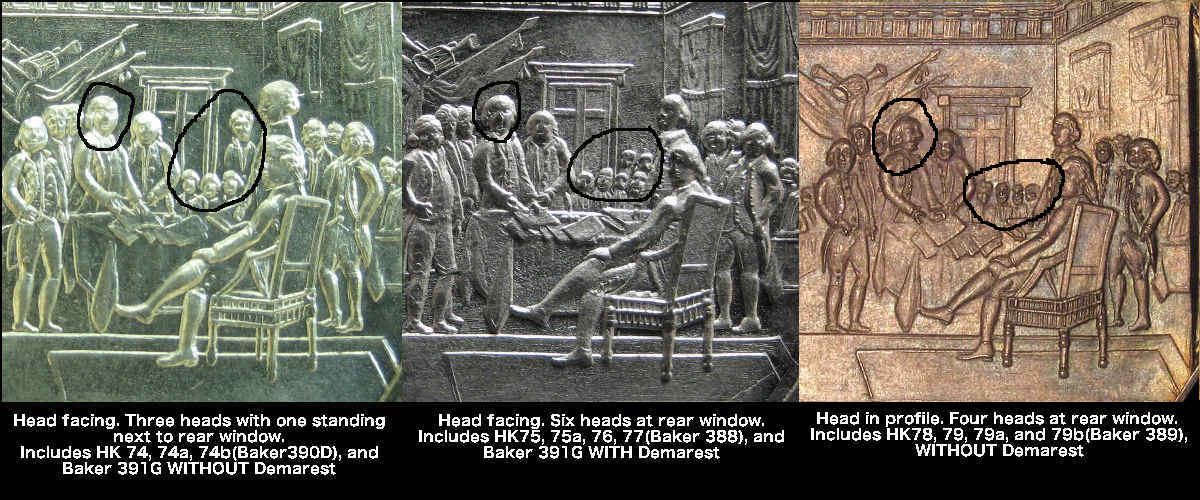
HK74 to HK79: The images of HK74 through HK79 in the newer 2nd edition of HK show all three varieties of the rectangular painting of Congress by Trumbull as found on so called dollars. Two of these images were missing in the 1st HK edition. For a close-up of these differences, Click Here. HK75 - HK77 has "Demarest. SC." below in tiny lettering. This is the variety that is not pictured in either the 1st edition of HK or Rulau/Fuld. The other two varieties have "Demarest. SC." omitted. I combined my tallies of HK78 - HK79 with HK75 - HK77, as the two were often not distinguished from each other in auction catalogs. Also, I have combined tallies of HK76 and HK77 as the difference between white metal and pewter might be negligible. Lastly, click (HERE) to view "John Hancock" varieties of HK74 and HK75.
HK80 Gilt: Stacks sold one in their November 2010 sale lot#49. I tallied another sale but did not record where it was.
HK80a: Tallies for HK80a are combined with HK80. This variety is not listed in the 1st HK edition.
HK85 and HK86: Joe Levine from his 74th PCAC sale lot#228 states: "HK catalogs this piece(and HK 85, its black gutta percha brother) as just a composition variation of HK 83 & 84. It is not! HK 83-4 is 41mm while HK 85-6 is only 38mm. In addition, 85-6 is struck from both different obverse and reverse dies. The inscriptions are the same as 83-4, but the letter positioning is different."
HK91-HK112: Click (HERE) for images of the smaller bust varieties.
HK114: Joe Levine from his 39th PCAC sale lot#618 states: "HK erroneously attributes this to the 1876 Centennial period. It is a good bit earlier" The 2nd edition of HK also includes Baker264F(HK114F) and Baker264G(HK114G). I did not tally either one of these two pieces. There is also another variety that combines the obverse of HK114 with a bust of W.H. Harrison(from Charles Kirtley sale #142 lot#AB47 with picture)
HK119: I have never found this piece in silver or silver plate as listed in both editions of HK. It is almost always found in bronze. The only white metal piece I found was from Johnson & Jensen sale #9 lot#1019 where it was described as: "(HK119a. Unlisted) Battle of Saratoga Monument Medal (circa 1877); white metal (unlisted as such). Bright AU". The ANS in New York also has one in white metal.
HK120: Joe Levine from his 58th PCAC sale lot#196 states: "In addition to the strikings in Bronze and White Metal as cataloged in HK, this piece was also struck in Silver, Brass, Gilt and Gold. 7 pieces were struck in gold for presentation to the First Lady, Mrs. Hayes, and others, and the dies were destroyed. A note in 13AJN 23 states that the dies were cut by Mr. Morgan". The nickel piece that I have listed here is from Johnson and Jensen sale #9 lot#1026 where it was described as "nickel (nonmagnetic)". Also, there were three silver plated pieces that I found from two Presidential sales and one Charles Kirtley sale.
HK125: From his 58th PCAC sale lot#197 Joe Levine states: "Accompanying this piece is an extract entitled, A Centennial Souvenir from the New London Telegram describing this medal and stating that the strikings were made in White Metal, Bronze and Silver from a design approved by the Groton Heights Centennial Committee"
HK127 in White Metal(HK127a in the 2nd edition of HK): From Charles Kirtley sale #10 lot#722 where it was described as "H&K UNLISTED. Similar to H&K 127 but with slightly different dies on both sides. Also unlisted by Baker. Rare. White Metal. CH AU-55" There was no picture.
HK131 silvered: Like other "rare": silvered so called dollars, the silvering on this piece was probably done sometime after the original striking. When an auction catalog describes a piece as "silvered", I usually assume that the silvering is much thinner than a more robust " plating, and that the silvering was not original, although it is hard to say without looking at the piece. I have been told that plated planchets can be struck without the underlying metal showing through, but certainly the plating would have to have a thickness to it, not a light silvering.
HK135a Copper-plated: The 2nd HK edition lists this piece as being copper plated, but Rich Hartzog and Joe Levine of Presidential Coin and Antique both described it as being copper in their auction catalogs. I do not know which description is correct, or if both are.
HK136 in Silver: Of the ten sales tallied, it appears that most were different pieces. The ten sales were as follows:1)Johnson & Jensen 9/16/79 lot 591. Part of a boxed set of three medals including one in silver. Described as obverse having slight nicks and reverse perfect. Was not graded specifically, but all three pieces were graded overall VF-AU. No photo 2)PCAC 6/25/88 lot 76. Described as choice about uncirculated with uneven blue & rose toning. No photo 3)PCAC 12/2/89 lot 280. Described as choice uncirculated with attractive pale gold and turquoise toning, and the choicest of the two specimens owned by Paul Magriel. No photo. This piece sold once again at the 12/8/90 PCAC sale lot 251, with photo. 4)PCAC 6/25/94 lot 146. Described as Choice uncirculated with attractively toned and proof surfaces. It was originally bought from Tony Swicer who noted that it was Ex-Dreyfuss, #5449. With photo. 5)Dick Grinolds 6/9/98 lot 1086. Described as xf+++-au with a small rim bump at 9:00 obverse. With photo. 6)PCAC 11/13/99 lot 339. Described as Choice deeply toned about uncirculated. With photo. This same piece also sold in PCAC 12/1/01 lot 471. This latter sale was after year 2000 so was not added into population numbers. 7)Bob Slawsky 12/1/99 lot 927. Described as Proof with light orange toning. With photo that appears to show some hairlines on the obverse field. 8) NASCA 6/6/78 lot 3810. Described as AU with beautiful iridescent toning. 9) NASCA 4/28/81 lot 1764. Described as Prooflike Choice AU with light golden toning, violet reverse, with prooflike fields and frosty devices and rims, edge bruise 1:00, minor contact marks.
HK139 in silvered Brass: This single piece is from Charles Kirtley sale #30 where it was described as: "This U.S. medal is struck in silver washed brass. Unlisted as such. Prooflike UNC-60....". A "silver washed" piece probably would have not been struck as such, but without inspecting it up close, who knows.
HK141 Silver and Bronze: The silver piece is from Stacks August 2016 sale, graded NGC MS-64. It is the only one I know of. In bronze it appears to me to be as rare.
HK143c: I have never seen this piece without a hole. Hopefully at least one exists somewhere without a hole.
HK143d: I have never seen this piece without a hole. One sold at Heritage August 15, 2022. It can also be found in TAMS December 1985 page 209
HK144c: I have found three of these in old auction catalogs in white metal: 1) Charles Kirtley sale #60 lot#C508 with no mention of a hole and no picture. 2) Johnson & Jensen #19 lot#558 described as having a brass eagle suspender. No picture. 3) Christensen and Stone sale April 30,1975 lot #7 with no mention of a hole and no picture. The American Numismatic Society in New York evidently has two of these in copper/bronze.
HK152 in gilt White Metal: This single piece that I located was from Presidential Coin and Antique sale #60 lot 917, described as "UNLISTED. SAME, as above but struck in gilt white metal. XF/AU. Thick (4.6mm) Planchet." It is possible that this is in fact the "Brass" piece(HK152) that the original authors of HK were referring to.
HK154 and HK155 in Silver: Two sales of HK154 in silver that were both described as VF30(and probably the same piece) were Charles Kirtley sale #26 lot#224(with photo), and the October 14, 1989 Charles Kirtley sale of the William H. Hale collection(lot#047A). Obviously a piece in VF condition would show through underlying medal if it were plated. Another HK154 in silver was sold by Paul Koppenhaver in October of 1996 lot#25. He described it as "Irridescently toned prooflike Abt Unc. But with some obv/rev rim mishandling marks. The only rim marks worth noting are (2) obv2:30 oclock and a lesser on 8:30 oclock. But this is extremely rare in silver and likely given to a senior Expo Official. The 1st we have handled and 2nd we have seen in decades in this hobby. The former owner valued it at $425 and hes probably not far off". For HK155 in silver, I know of two sales. One was Charles Kirtley sale #89 lot#2188 described as EF-45(with photo). The other was Johnson & Jensen sale #9 lot#1056 described as AU. Also Stacks sold a silver HK154 in their October 2014 sale lot#3058
HK154 and HK155 in Aluminum: The 1978 "Current Valuations" guide lists HK155 in aluminum. HK154 exists in aluminum and is quite rare, but I have never heard or seen of an HK155 in aluminum. Tony Swicer had three aluminum HK154 examples in his 1992 fixed price list sale. He stated in the sale that there were only four known.
HK159a: This piece is listed in the 2nd HK edition as having the same reverse as HK159, but there are a number of differences, most obvious of which is the order of the listing of the five adjectives. The obverse of HK159a has the same obverse as HK236a. As a matter of fact, the reverse die of HK159a is actually larger than the reverse die of HK159 even though they are very similar in design. The HK159 that I own measures 34.4mm in diameter. An HK236a that I have measures 37mm. I also have a mule of the reverse of HK236a combined withe reverse of HK159a. It also measures 37mm in diameter. When I compare the reverse of my HK159 with my mule that has the reverse of HK159a, it is obvious to the eye that the reverse die of HK159a is larger than the reverse die of HK159 - by about 2.5mm. I have never found a HK159a before the publishing of the 2nd edition of HK. The HK 2nd edition lists HK159a as being R4 in rarity. I would say that it is quite a bit more rare than that. The reverse of HK159a is an especially rare "ALUMINUM" reverse. HK159a should probably have been more properly placed after HK236a in the second edition of HK as a variety of HK236a.
HK162a: The obverse of HK162a is very similar to the reverse of HK171. The ornamental designs between the four outer circles of the obverse of HK162a are replaced by "grass-like" extensions on the reverse of HK171. Also note that the flag flies in different directions on the Administration building. There are of course many different die combinations of aluminum World Columbian pieces, all made by Childs of Chicago. The obverse die of HK162a and the reverse die of HK171 are good examples, both being combined with a number of different dies; however it turns out that the obverse die of HK162a appears to be slightly smaller than the reverse die of HK171, so all the various dies combined with HK171 do not ever appear to have ever been used with the dies HK162a, and visa versa. At some point it would be nice to do some sort of study of all the different World Columbian so called dollar die combinations.
HK163: HK163 has always appeared to me to be the same as HK161. I have never found any piece in any auction/sales catalog that was described or listed as HK163, so in fact maybe they are the same.
HK169 in multiple platings: Probably all plated after sometime after minting.
HK170: Exists with "Height" spelled correctly and with "Height" misspelled "Heigth". My tally numbers for both varieties are combined.
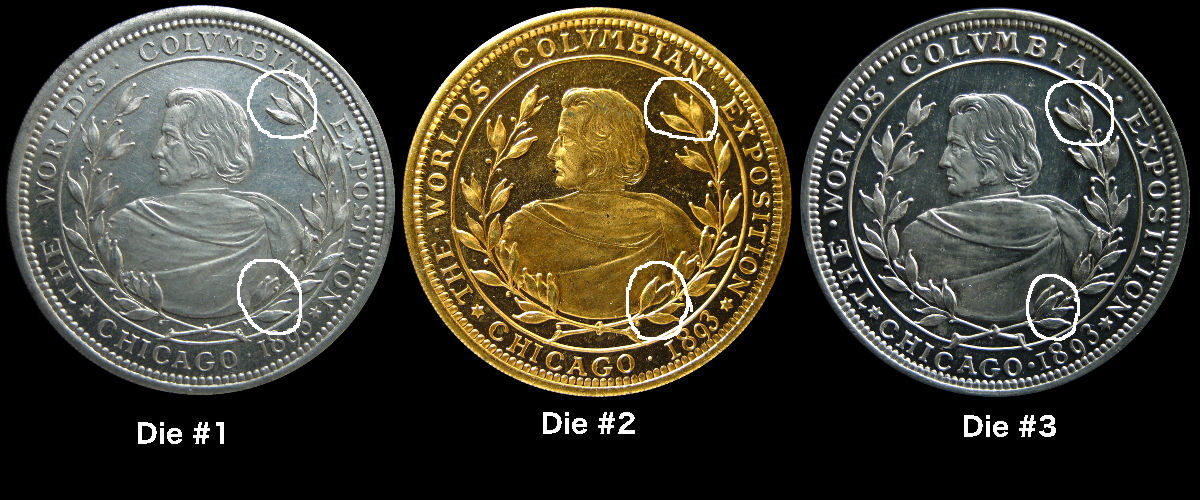
Palace Dollars: EDITED AUGUST 2022: NOTE: ORIGINALLY I STATED HERE THE FOLLOWING - QUOTE: " Overall, the mules and portrait pieces appear to be equally rare." WELL, THAT STATEMENT WAS NOT ENTIRELY TRUE, SO SOME OF WHAT FOLLOWS HAS BEEN RE-WRITTEN: Palace dollars(HK176-HK203) come with two different obverse die varieties, and even a third obverse die that thus far I have only seen with HK208. I have an HK207 that uses die #1, and it looks as if the one pictured in HK also uses die #1. Click Here for images. Also, a few years ago I did a small study using my tallies for World Columbian palace dollars(HK176 - HK203). I found a grand total of 372. By amazing luck or whatever, I found a total of 159 described as gilt, and EXACTLY the same number of aluminum pieces for a total of 318. Of the remaining 54 pieces, 40 were described as silver plate or occasionally silver(they were most likely plated), and 14 were described as copper or bronze. What was interesting was that when I looked at the tallies of brass verses aluminum of all pieces with the portrait of Columbus on one side vs those that might be called mules of building reverses(HK177a, 181a, 183a, 185a, 192, and 203), I found 133 portrait pieces in brass and 99 aluminum portrait pieces, so from this study the brass portrait pieces appear to be about 30 percent more common than the aluminum. On the other hand I found only 26 of the mules in brass, vs 60 in aluminum. So the mules seem to be more common in aluminum, the portrait pieces more common in brass. Also, the mules were obviously not done randomly or willy nilly. Each reverse was paired with another specific reverse but no other - the Administration Building with the Fisheries, the Horticultural Building with the Forestry/Transportation etc etc, for a total 6 pairings of all 12 reverses. Overall, the mules and portrait pieces as individual pieces appear to be equally rare if you add up just the gilt and aluminum pieces together. However if you also include silver plate and copper pieces, the mules appear to be overall rarer due to the fact that the copper and silver plate pieces are much harder to find as mules. Of the 372 pieces that I tallied, I found 37 silver plate columbus portrait pieces, but only 3 silver plate mules. I found eleven described as copper(some were possibly bronze - I am not sure), but only three copper(bronze?) mules. Silver plated pieces were obviously rarer, with copper pieces being the rarest, but copper, bronze and brass can be confused with each other if worn or with aquired patinas. Recently I did specific gravity testing on a number of gilt/brass pieces, silver plate pieces, and one piece that I had that looked copper. The copper looking piece did in fact have a specific gravity of nearly 9 which would indicate pure copper. The gilt/brass looking pieces and the silver plate pieces all had distinctly lower specific gravities than the copper one which would indicate some sort of brass/bronze alloy. In fact, the silver plate pieces all had slightly LOWER specific gravities than the gilt pieces which might indicate that the underlying alloy used for the silver plate pieces was different from that used for the gilt ones. Old catalogs described the gilt/brass pieces as either gilt or brass. It now appears that all are gilt, however it is possible that un-gilded pieces do exist. When worn, the gilt pieces can look as if most or even all of the gilding has worn off. The plating on the silver plated pieces appears to be thicker than the gilt ones and rarely wears through to the underlying metal.
EDITED AUGUST 2022: Exhibition Palace Dollars in Silver Plate or Silver: An area of confusion is whether some Exhibition Palace Dollars exist in solid silver, or if all "silver" pieces are in fact silver plate. There is no question that they exist as silver plate, and it appears that they were plated that way prior to striking. I have an example in uncirculated condition where a large patch of plating has completely come off revealing the underlying metal. The plating on this piece is not a light silvering. If it was not for the plating coming off, it could very easily pass for solid silver. The William Hale collection of Columbian Expo medals sold by Charles Kirtley on October 14, 1989 lists a number of Exhibition Palace dollars in both silver, and what he describes as "silver washed brass". It is possible that those described as silver were in fact silver plate, and that the ones described as "silver washed brass" were pieces that were more lightly silvered after striking. Also, in the HK 1st edition, a few Exhibition Palace dollars were described as being made of silver, but none described as silver plate. As we know that many if not all exist in silver plate, this leads to the strong possibility that those listed as silver were also in fact all silver plate. Also, in 1992, Tony Swicer sold a number of Exhibition Palace dollars. He described two as being silver, but none were listed as silver plate. Once again, those that he listed in silver may have been plated. Thus, all of my tallies for Exhibition Palace dollars in silver, may in fact have all been silver plated, with most if not all silver plated brass as the 2nd HK edition states. But who knows, with testing, maybe some will eventually be found to be solid silver. I have five silver plate pieces, all with specific gravities that measured below 9. Silver pieces are going to have a specific gravity of over 10. Simply weighing a piece may not be definitive because planchet weights due to varying thicknesses made of the same metal can vary. It appears that NGC does distinguish between plated pieces and solid metal pieces using various methods. I imagine that PCGS does the same.
HK205: My original tally for this piece was 6 total. Unfortunately I did not tally in 8 other pieces that were sometimes described in various sales catalogs as being "unlisted - Reverse of HK168 combined with the Reverse of HK171". These pieces were in fact not unlisted at all, but were in fact HK205 pieces. The first edition of HK did not have a picture of HK205, but did have pictures of HK168 and HK171 in close proximity to each other, which is why sellers were sometimes in error. At any rate, I have now tallied the pieces in properly for a total of 14 pieces. As I looked through sales catalogs, I found other HK numbers that were also sometimes mistakenly described in the same way, but I can assure you that I did not make the same mistake with those that I made with this piece. Anyway, I am sorry if my original tally was misleading. World Columbian pieces are especially confusing because of all the die combinations.
HK213: Comes in two varieties; one with copyright wording, and one without.
HK220-HK222: These pieces come in high and low relief. The high relief pieces are widely known to come in aluminum, gilt, and bronze, with the aluminum ones being the most common. They are quite attractive and are very often found in high grade. In high relief this piece is also known in silver, but is quite rare. Barry Friedman sold one on ebay a few years back. I have never handled one of these, but the picture of Barry Friedman’s piece on ebay was quite convincing. The sole high relief example in white metal that I recorded was from Charles Kirtley sale #154 lot#Y083 where it was described as "same(HK222) but white metal. AU-55 in box. Box is broken". In low relief this piece is found in aluminum, and is rarer than the high relief variety in aluminum. Low relief pieces are also found in other metals, but are a bit hard to come by and the ones I have seen were worn. I own one in brass. When Tony Swicer sold his collection in 1992 he listed five pieces in five different metals that he described as being like HK220-222 but with "similar dies". I am guessing (but I am not sure so I did not list them)that what he meant by "similar dies" was that they were all of the low relief variety. The five that he sold were aluminum, gilt, bronze, silverplate, and silver. The newer 2008 2nd edition of HK lists the bronze piece as HK220a. Lastly, it is possible that my tally of HK222 in low relief (HK222a in the new edition)is a bit on the low side due to the fact that a few of the low relief examples that I found may have been tallied with the high relief examples. Nevertheless there is still no doubt that the low relief variety is rarer than the high relief variety.
HK230 Bronze/Copper: Two bronze pieces from Charles Kirtley sale 10/14/89(lots#025 and #026) were described as being struck on a 2.5mm and 3.5mm planchets.
HK234-HK236: The first edition of HK describes the obverse of HK235 as having the same obverse as HK234. The second edition of HK describes and shows HK235 as having the same obverse as HK236. My tallies for the first edition of HK are for HK235 as described in the first edition. My tallies for the second edition of HK are for HK235 as shown in the second edition of HK. Both tallies are similar, so I guess it is of no consequence anyway. But it could be that sellers also got the two pieces confused, so my tallies may not truly reflect their relative rarities. A study that I did strongly suggests that these pieces were made by William Warner and Brother of Philadelphia.
HK241: Two different die varieties both included in same tally figures.
HK245: I found two sales that were described as copper or bronze. One was Presidential Coin and Antique Co sale #69 lot#1153 that was described as "HK245 but copper". The other was Steven Alpert sale #2 lot#710 that was listed as bronze. I suppose it is possible that one or both of these could in fact have been brass with patinas. Brass that has acquired a patina can sometimes look decidedly bronze. There were two intriguing error/die trials of this piece in the 2008 Bill Weber auction held in Reno Nevada lots 10259(1011) and lot#10260(1012). Full descriptions of these pieces can be found in "So-Called Dollars From The Pacific Coast Expositions" by Jeff Shevlin and Bill Hyder. I found no sales of silver plate pieces in any of the auction catalogs that I looked through. Any gold plate/gilt tallies were combined with my brass tallies.
HK245a in other metals: A silver-plate piece was sold at the Bill Weber auction in Reno Nevada December 2008 lot#10262. An aluminum piece sold on ebay July 2010. I found no aluminum or plated pieces in any of the catalogs that I looked through. Any gold plate/gilt tallies were combined with my brass tallies. There is also a rarer example of this piece with a "Wide" EUREKA. Click Here for example.
HK250 in gilt Bronze/gilt Brass: Jeff Shevlin and Bill Hyder state in their book of "So-Called Dollars From The Pacific Coast Expositions" that the gold plated variety of this piece has a specific gravity of 9.2. This is very unusual. It is rare to find any coin, token or medal to have a specific gravity somewhere between 9 and 10. Pure copper’s specific gravity at just under 9 has the highest specific gravity of all the base metals. All silver so called dollars that I have tested(about 100) have had specific gravities of at least 10.0, most having specific gravities of above 10.25, with a few below 10.25, but all above 10.0. Anyway, most unusual. In past auction catalogs that I have looked through, these gold plate pieces were always described as plated bronze or brass, but I doubt any specific gravity testing was done.
HK252 and HK253 Occasionally found with date stamped on reverse. Click Here for examples
HK268: The single copper piece is from PCAC sale #58 lot #984. It was described as "....struck in Copper. R&B Unc. Unlisted in this metal". The silvered piece was from PCAC sale #49 lot#768, and was described as "Rare variety that is silvered rather than gilt. Uncirculated, with mottled toning. The first we have seen silvered".
HK274 in Silver: The only one of these I found in silver was from PCAC sale #45 lot#1128. It was described as "HK-274. Tennessee Centennial Expo Official Medal. In Silver. AU. Struck by U.S. Mint."
HK276 and HK277: I have a matching pair of these, HK276 and HK277, that look either brass or gilt(HK describes these as brass). I also have another HK276 that looks decidedly bronze. The "bronze" piece does not show much wear so the chance that any plating might have somehow come off is slim. Also, brass can acquire a patina that can make it look bronze, but I do not think that is the case here. I decided to do specific gravity testing on all three. The matching pair both had specific gravities that were virtually the same - just over 8.8, but the piece that looks bronze had a somewhat lower specific gravity of 8.6. A specific gravity of 8.8 is possibly a bit high for brass, but too low for pure copper. Bronze has a wide specific gravity range depending on how it is alloyed. At any rate, at this point I am not sure of the metal content of either one, but obviously there is a difference, so for now I am calling one brass/gilt, and the other bronze. All are tallied together. The single silvered brass tally that I found was from Paul Koppenhaver sale June 6, 1987 lot#195. It was described as "silvered brass, XF". I am guessing that it was probably silvered sometime after striking.
HK278 and HK278a in the 2nd edition of HK: More common in white metal, but difficult to find un-holed. The sole bronze example I found was from PCAC sale #68 lot#1351 where it was described as "HK 278. 35mm. Chocolate Bronze Unc...."
HK283: Six of the total here were described as gilt. In fact, all brass pieces could be gilt.
HK284 in Silver plate: I bought this piece from PCAC sale #78 lot#184. It was described as silver and "Hairlined About Uncirculated" and "From the Wayte Raymond Sale, #4155. We know of no other example.". Years later a specific gravity test I did on this piece revealed a specific gravity of just under 9, so what ever it is made of is not solid silver. In the previous Wayte Raymond sale(NASCA sale June 6 1978 lot#4155) it was also described as silver. At this point I am not sure what it is made of - perhaps silver plated copper, but no underlying metal appears to show through on the high spot wear, and it actually has a sort of "nickel" look to it. It also has some strange doubling on some of the obverse lettering. I have been in the possession of a lot of silver so called dollars over the years and have specific gravity tested virtually all of them. The vast majority, including a number of rare silver pieces from the 1876 Philadelphia Exposition, happily all turned out to be solid silver, often 99 silver, as described in various sales.
HK289: My guess is that all of these pieces are gilt bronze or copper, not brass as described in HK. The high spot wear on these pieces always seems to have a copper/bronze look to it.
HK292: The gilt and copper pieces were from PCAC sale#58 lot#1007 and lot#1008. The gilt piece was described as "....struck in gilt copper. Choice AU.". The copper piece was described as "....struck without being silvered or gilded. Choice R&B AU."
HK296: Beware of cast copies of this popular so called dollar. They are not common and not very convincing, but they are out there. Original pieces often have a grayish tone to them from having been stored in their original dark reddish brown box with blue interior. One distinguishing characteristic of original pieces are their sharp rims, which also helps when grading them. Nicer high grade examples of these pieces will have ding free rims, or at least nearly so.
HK300 and HK304: I am not sure why the authors of HK made two separate entries for gold plate and gilt. HK300 and HK304 might be the same or nearly so(?)
HK305 and HK306: Statements in HK seem to coincide pretty well with numbers that I found. HK states that less than 25,000 of the round ones were sold to the public, but that a full 25,000 of the octagonal ones were later sold to dealers. Obviously the number of round ones sold was considerably less than 25,000 if in fact there were a full 25,000 of the octagonal ones sold. Also, the octagonal ones are usually found in nicer condition. This also makes sense if in fact the round ones were sold to the public, while the octagonal ones were sold to dealers sometime later. Of the 119 octagonal pieces that I located, only 15 were graded below AU. Of the 37 round ones that I found, 21 were graded below AU, a much higher percentage.
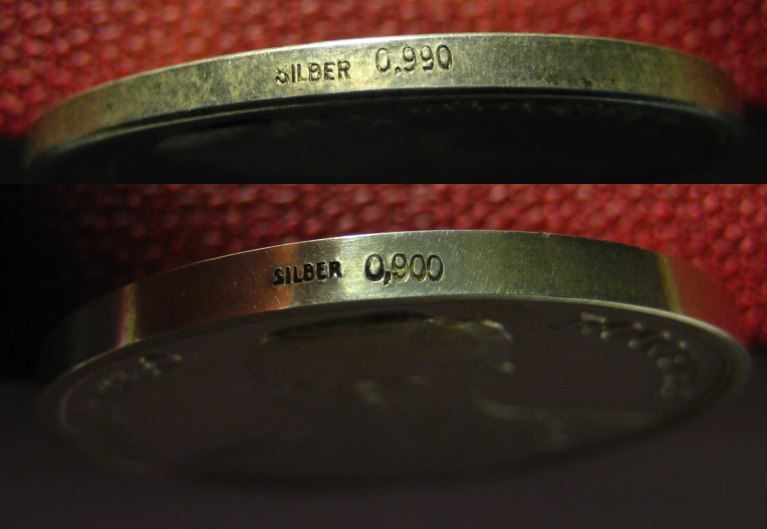
HK308: I did some specific gravity testing of a number of my silver so called dollars. I happened to have two HK308s to test. Of course I expected the testing of both to come out similar. Well, such was not the case. To start with one weighed a little over 23 grams. The other weighed a bit over 27 grams. The specific gravity test on the 23 gram piece came out to very near 10.5, which would indicate pure silver, and indeed that matched a tiny punch on the edge that read "SILBER 0.990", or 99% silver. Then I did the same test on the 27 gram piece. It came out with a specific gravity of slightly over 10.3, which would indicate something similar to coin silver. Sure enough when I looked at the edge of the second piece, it read "SILBER 0.900 " or 90% silver. Thus, there are two varieties of this piece. I have no idea which is rarer. They were both 38.2mm. The 27 gram piece is thicker. These were made in Germany, thus the use of the word "silber". IMAGE
HK310 in Silver: The only one I know of was from the Ostheimer sale in 2011 handled by Jeff Shevlin.
HK313: In the 2nd edition of HK, the plain and reeded edge pieces are given the separate designations of HK313 in brass and HK313a in gilt. My tally for this piece includes both varieties combined.
HK328: I have kept HK328 antiqued silver and HK328 silver plate as separate entries, but in fact it may be that all pieces are silver plate. If so, then a lot of collectors over the years have bought these pieces thinking that they were silver. HK328 appears to be the most common of the Lewis & Clark conjoined bust pieces. In old catalogs this piece was occasionally described as being silver without being antiqued. The silver plating on these pieces may be quite thick, which may be why they have been mistakenly described as being made of solid silver. More specific gravity testing needs to be done on these pieces. I have only test one example. It looked silver but had a specific gravity of 8.9. I have not seen HK328 described with loops. I have seen HK329 described as both copper or bronze, and HK330 as either gilt copper or gilt bronze; and both occasionally with rabbit ear loops and pin back hanger. I did not locate very many of these pieces in gilt(HK330), but Terry Trantow's June 1968 TAMS article also shows that this piece exists in gilt. I am still a bit confused though. Jeff Shevlin and Bill Hyder's book on "So Called Dollars From the Pacific Coast Expositions" does not list this piece in gilt/gold plate. Also, there is a piece with rabbit ears from an old Charles Kirtley sale with image that is described as HK330, but the image looks like an HK331a, not an HK330. It could be that any piece designated as HK-330 could be mis-attributed, and could in fact be an HK-331. If anyone finds a true HK-330 in gilt, loops or not, 34mm in diameter, WITH date, let me know. My tally of ten certainly suggests that they exist as such, but Lewis and Clark pieces may have been easily confused in old auction catalogs and mis-attributed.
HK331 and HK331a: Unlike the larger and smaller versions of the conjoined Lewis and Clark pieces, this 36 mm version only exists in one type, in three metal compositions, with aluminum being by far the rarest.
HK332 and HK332a: There are two distinct varieties of this piece in 38mm size. One has "Lewis And Clark" around above, the other has "Lewis & Clark" around above. The "Lewis And Clark" variety is paired with a cracked reverse die. The "Lewis & Clark" variety has a different un-cracked reverse die with lettering farther away from the rim and other differences. See "So Called Dollars From the Pacific Coast Expositions" by Jeff Shevlin and Bill Hyder for an excellent explanation of these dies and how they relate to the Washington State variety(HK334) of the same size. The book describes the "Lewis And Clark" variety as being made of brass where as HK describes this variety as bronze. I did not ever find either of these 38mm varieties with loops. Also, there is an older article about the Government building varieties in TAMS journal June 1968 page 65 by Terry Trantow. It appears that SH14-5 as listed in Jeff Shevlin and Bill Hyders book is missing from this 1968 article. SH 14-6 IS depicted with a hole that appears to have obliterated the "&" between "LEWIS" and "CLARK".
HK333: Same diameter as HK328-HK330, but this time without a date. I have never located one in silver as described in HK for HK333b. Like HK328, all are probably silver plate.
HK334: There are three different die varieties - one with "Lewis And Clark" around above using the same cracked obverse die that was used on HK332, and two varieties with "Lewis & Clark" around above. A full explanation, pictures, and descriptions of these varieties can be found in "So Called Dollars From the Pacific Coast Expositions" by Jeff Shevlin and Bill Hyder. My tally numbers are a combined total of all three varieties.
HK335 to HK338: US Mint figures state that there were a total of 250 silver proof pieces minted, and the same number of gold plated pieces minted; but there is no question that today the gold plated pieces are considerably rarer. The mintage of the silver proof pieces was probably higher than the stated Mint figures, but not anywhere near as high as the oxidized silver(HK336 - 4200 mintage) and bronze(HK338 - 6250 mintage) pieces. Also, I am not absolutely sure, but you might want to be aware of gold plated pieces that may have been plated sometime after striking. Look for somewhat matte-like surfaces(grainy), and under a loupe look if that graininess goes down inside any bag marks. One legit piece that I have seen was bright Unc. Bag marks should always look bright and shiny.
HK339: Have seen it described as having two loops with a quot;Souvenir" pinbar. Listed in Brass in HK, but gilt Brass is probably more accurate.
HK344 and HK345: I have done specific gravity testing on three of these, and they all came out somewhere near coin silver/sterling silver - specific gravities of approx. 10.3, so at this point I am guessing that at least most are solid silver. However as you can see from my tally, some are described in old auction catalogs as being plated.
HK349: Different die varieties exist. Population numbers include all varieties. The sole nickel plated piece that I found was from Charles Kirtley sale #89 lot#2361. It was described as "Like H&K 349, but NI pl....in CH AU".
HK349a: I did not tally this piece, so I have no idea as to how rare it is.
HK349b: Although I believe my tally to be accurate, my tally of ten pieces is a bit surprising to me. It has been years since I have seen one of these come up for sale, and NGC(as of January 2018) has no listing for this piece in their census. At the very least it is obviously very difficult to find in nice condition.
HK350 in Gold Plate or Brass: I found one of these described as "gold plated"(Stephen Alpert sale #54 lot#1146), and another described as Brass(Christensen and Stone 4/30/75 lot #26).
HK351: Exists with and without dots before and after "To Pacific Coast". Tally numbers include both varieties. A note about the no dot variety is included in the description of HK352b in HK.
HK353: I found that occasionally some of these pieces were described as silver plated or copper plated. They were possibly plated sometime after striking. I own a copper plated piece that does not look original. Specific gravity tests I did on two silver examples tested at around 10.35. The sole white metal example that I located was from Rich Hartzog World Exonumia mail bid sale #5(12/1/80) lot#2638 where it was described as "HK 353, but in W-M, with top loop. AYPE Official seal, etc. XF".
HK357: Virtually all pieces have either been fobbed or with the fob removed. At least one in bronze is known to exist with a reeded edge and without a fob. There are also other varieties of this piece, including one with a bust of Seward on the obverse, and also some "palace dollars" that are quite rare. Click Here for examples.
HK358: When I first bought one of these I thought that it had impaired luster, possibly having been over dipped or maybe even put through some sort of an acid bath. The luster was poor and upon close examination the surfaces had a matt-like appearance on all of the fields and devices. Sometime later I took possession of a second one. It had the same kind of surfaces as the first one. So I am guessing these pieces tend to have poor luster. This is in contrast to HK359 which often shows attractive copper luster. The edges of both silver pieces that I examined were nice and smooth with sharp rims, similar to the copper pieces. The "STERLING" stamped on these pieces is in a slightly different position on each piece, and so, as you would expect, were stamped after striking. HK358 is quite rare. Even where I am from in the Pacific Northwest, these pieces rarely come up for sale.
HK359 in Silver: NGC has evidently encapsulated a silver one of these with the reverse of an HK359, not the reverse of HK358.
HK360: Different die varieties evidently exist. All are combined into the same numbers tallied.
HK361: Evidently exists in gold plated silver and un-plated silver. It may not exist in bronze as listed in the first edition of HK. It is unique in gold. Presidential Coin and Antique Company sold one of these in gold plate in their 56th PCAC June 1994 sale lot#151. In the auction catalog Joe Levine states: "We note in the HK description and in the photo of HK 361, that on the lower right edge of the reverse there appears the numerals "900". This marking usually denotes the purity of the precious metal content of the item. Query: Did HK mistakenly identify the metal of their piece as Bronze, or did even bronze examples have this "900" on the die that struck them? We suspect, without really knowing that all pieces are in Silver. The only other known example of HK 361 we have ever seen, (Middendorf Sale, #253) was also in silver (not gilded). That piece brought an impressive $577.50, attesting to its true rarity.".
HK363 and HK363a: Look at "So-Called Dollars From The Pacific Coast Expositions" by Jeff Shevlin and Bill Hyder for a looped example from a different die, and an interesting lead die trial.
HK364: In the first edition of HK the obverse of this piece was described as "Obv. Same as No. 353" which would suggest that the correct obverse of HK364 is the OBVERSE of HK353; but in the second edition of HK, the obverse of HK364 is shown as the REVERSE of HK353.(This confusion has since been corrected and updated on the HK book website at so-calleddollars.com, and listed as HK-364 and HK-364a), or for images of both varieties, Click Here. The tally that I have for this piece may very well include both types. Both varieties of HK364 are a bit of a unique problem with regard to what should be included as a so called dollar. They are both 32.2 mm in diameter, the same diameter as HK353-HK356. This makes all three of these types(HK353-HK356, HK364 first edition, HK364 second edition) the smallest medals in HK and also distinctly under the 33 mm diameter minimum that so called dollars are suppose to be(if you really want to split hairs here, the absolute minimum diameter of a so called dollar should be 32.5 or 32.6 mm which rounded off to the nearest whole millimeter would be 33 mm). I am sure the reason that the original authors broke their rules here was due to the fact that HK363 is a US mint product AND an official medal of a worlds fair. The problem was that this left the barn door open a crack for other undersized pieces. And sure enough both HK364(first edition), and HK364(second edition) are also allowed in. The authors may not have even been aware of the second HK364 type. But anyway, so what. Traditionally all three types have been included as so called dollars. Personally I do not see why that has to change. Maybe someday if someone puts together a so called half dollar reference, these pieces could be included too. My one tally in silver plate was no doubt plated as a novelty sometime after striking. Also, one last note here due to possible past confusions: the reverse of HK364 is very similar to the reverse of HK366a in the second edition, but there are differences. The reverse of HK366a has beading around the rim and a period before "U" of U.S. Also, HK366a is obviously larger than HK364.
HK366a: HK366a is listed in the 2nd edition of HK, but not the first. It is possible that in a few of the auction catalogs that I looked through HK366a was described as being HK365 or HK366, and thus I would have tallied it with one of them; thus HK366a may not be quite as rare as my tally would indicate. Nevertheless, it is still rarer in my view than either HK365 or HK366. For a further discussion of the different AYPE varieties, click HERE
HK367 and HK367a: This so called dollar comes with two obverse dies. One has the two lower branches on the right side pointing at the "’KA" of "Alaska". The second version has the same branches pointing at the "SK" of "Alaska". The "KA" variety is more common by about 5:1. Occasionally found looped. My tally includes both varieties together. I have never located one in bronze as is listed in the second edition of HK, however in worn condition, brass can take on the look of bronze. ClickHERE for a third variety(Shevlin SH 16-15) that is not listed in HK. For excellent images and descriptions of all three varieties, look at "So-Called Dollar From The Pacific Coast Expositions by Jeff Shevlin and Bill Hyder. The sole silver plated piece that I found was from Presidential Coin and Antique Co. auction #45(12/3/88) lot#1157. It was possibly plated sometime after striking.
HK368 and HK368a: The three varieties of this piece are pictured in Jeff Shevlin and Bill Hyder’s book of "So-Called Dollar From The Pacific Coast Expositions". One variety has a colon after "Exposition" and dots before and after "Building" on the reverse. The other two are missing the obverse colon. All three are included in my tally as a single entity.
HK369: My numbers for HK369 (HK369 and HK369a in the second edition) are combined to include those with "Med. Art Co." on the edge, and those without. I do not know which is more common. I have always felt that the mintage numbers of this piece as stated in both HK and Delorey were low. HK states "less than 75", Delorey states "between 50 and 100". Although certainly not common, the numbers that I found suggest a higher mintage. The fact that some come with, and some come without "Med. Art Co" on the edge obviously suggests different strikings. Those with "Med. Art Co" on the edge were one of the first medals struck by the Medallic Art Company.
HK369 in Bronze: Delorey lists this piece as being unique, but Joe Levine from his June 25, 1988 PCAC sale, lot 199 states "we have handled only one other". PCAC also sold one in their sale #70 lot#482. Tony Swicer sold one in his 1992 sale (I did not tally this piece into my study). There was evidently a fourth sale that I located and tallied, but I did not record where I saw it. Tony Swicer’s piece was listed as Unc while Joe Levine’s two sales were described as being AU. Thus, although it is possible that some of these pieces were the same piece, it is unlikely that all four pieces were the same. Both of the PCAC sales were without the Medallic Art Company edgemark. Tony Swicer's sale makes no mention of an edgemark either way.
HK370: HK states that fewer than 200 of these were struck, but Delorey states: "a total of 205 pieces appeared in seven lots in Elder’s 12-13-29 sale". Delorey also mentions that Thomas Elder seemed to never throw anything away, which might explain the existence of these dies years later. From my tally I would say it is pretty obvious that there are more than 200 in existence.
HK371- HK374: Sets of three of these in gold, silver, and bronze have occasionally been sold, one set in the June 6th 1978 Wayte Raymond NASCA sale lot#4193. Overstrikes evidently exist on a 1907 Honduras one centavo, a 1909 Lincoln cent, and possibly others. There are also some mulings, some of which are also overstruck on coins. For a more complete discussion of all of these, look at Presidential Coin and Antique auction #60 lots #119-123.
HK375 in Aluminum: I located two sales of this piece; one was Presidential Coin and Antique Co(PCAC) sale #22 lot#703. The other was PCAC sale #63 lot#234. DeLorey states "the aluminum striking is possible though not listed in any of Elder's auction catalogs".
HK379: From Part 1 of his 38th Presidential Coin and Antique Co(PCAC) sale lot#132 Joe Levine writes: "HK comments that "research fails to establish origin of these issues." That mystery is now solved, for this silver medal is suspended from a blue, white and orange ribbon which is attached to a silver top bar inscribed COMMISSION. The medal is housed in a leather box lettered, THE HUDSON-FULTON CELEBRATION COMMISSION. Struck by the Medallic Art Company...". There was also a similar description of this piece in a March 1982 Johnson Jensen sale lot#1427 with the same colored ribbon, but that piece was described as &qout;white metal silverplate". That is the only one of these pieces that I have seen described as white metal. Two other of these pieces sold in PCAC auction #56(6/25/94)lot#1213 and lot#1214. One was described as having the same blue/white/orange ribbon but with a light greenish-blue back ribbon. The other was described as " XF/AU, but this one has a white back ribbon and is housed in its original, but rather battered and inscribed leather presentation box". It appears that all those in silver are looped, but a few of the bronze examples may come without a loop, although it is likely, like the silver, all come with either a loop or loop removed.
HK381 and HK382: These occasionally come with a hanger and pinbar. For an example click HERE and scroll down.
HK389: My tally shows that only eleven of the eighteen total were holed, but I am sure that is because some of the auction descriptions did not describe their pieces as holed, assuming that everyone would know that anyway. They are quite rare un-holed. The only un-holed ones that I have seen sold at the Bill Weber Holabird December 2008 auction held in Reno Nevada(lot#s 10345 and 10346). One was in brass(quite rare), and the other was in bronze. This piece is also found silver plated at times. Two examples are from Rich Hartzog auction #2/26/79 lot#1029, and NASCA sale 6/6/78 lot#4199. The Bill Weber auction also had one in silver plate.
HK390 in White Metal: May not exist - read Delorey#78
HK395 gilt: In Charles Kirtley sale #22(October 21, 1986) lot#159 the description was "H&K 395. AU-50. Appears to be gilt". This is the only one I found described this way.
HK398: These pieces evidently have a mintage of 50,000, virtually all of which are serially numbered; but finding any with a serial number above 25,000 or so is extremely difficult if not impossible. Although this piece is somewhat common for a so called dollar, the total that I located do not suggest a mintage as high as 50,000. HK states that "Disposition of issue, following passage through canal, is not known.....". I have never heard or read anything about where the rest of the mintage could be if in fact they exist at all. Occasionally these pieces can be found with a box. PCAC sale 50 had three such pieces (lots 898, 900, and 901). One box was described as "original un-inscribed cardboard box of issue". The other two boxes were no doubt the same. HK398 goes for a premium when found with a low serial number. In the 2nd edition of HK, a new entry was created for pieces that are marked "specimen" where the serial number is usually located. I ran across two of these. One was Stephen Alpert sale 57 lot 1670. The other was Charles Kirtley sale 21 lot 1227. The 2nd edition of HK also made a new entry for pieces found without any serial number. I believe (but I am not positive) that the only one of these that I found was from Tony Swicer’s sale in 1992 where it was described as "398a Silverplate No Serial #"
HK399, HK400, HK401: Although this official Fair medal is commonly known to exist in silver, bronze and gilt, there are also a number of other related bronze compositions. There are images and a discussion of these in ":So-Called Dollars From The Pacific Coast Exposition" by Jeff Shevlin and Bill Hyder. Silvered bronze and white metal pieces are copies. I found a small number of gilt examples that had loops added on. Of possible interest was a bronze example that was sold by Presidential Coin and Antique Company, accompanied by an envelope that stated: "…produced at the Government’s minting demonstration at the Exposition and sold by the Exposition Department of Official Coins and Medals". Also, an HK399 sold at Stephen Alpert’s 1986 mail bid sale #25 that had "Aug. 15-1914" engraved on the edge.
HK402: When the first edition of HK was published in the early 1960s, this medal was quite rare. But then a year or two later restrikes began to appear on the market, all looking very much like the originals. Thus today this medal is much more common. To distinguish between the originals and the restrikes, look at the six curls below the date on the reverse. On the restrikes the far right curl looks as if it was retooled. It is thicker than the far left curl and with a few added retooling flaws.
HK414: Two reverse die varieties, one with six small portholes on the side of the ship, and one without.
HK416a: This piece is found in the 2nd edition of HK, but not the 1st edition. I found two sales of this piece, both in aluminum. One sale was Kurt Krueger sale #142 lot#2907. The other was Christian and Stone sale from 10/31/68 lot#289 which I did not tally. I did not enter any tallies from The Christian and Stone sales prior to 1973 due to too much repetition from one sale to the next. I have never found any in copper. Prior to the 2nd HK edition, I had never actually seen one in any metal. The example in HK shows a die crack which sometimes indicates that the dies were retired early thus contributing to it's rarity.
HK417, HK418, HK418a: The authors of "So-Called Dollars From The Pacific Coast Expositions" state that they believe that all pieces are gold plated. Brass can easily be mistaken for gold plate, but I also have three auction tallies in bronze. Personally I cannot remember seeing one of these in bronze, so perhaps my bronze tallies were pieces in lower grade that over time took on the appearance of bronze. At this point I am not sure. Gilt/gold plate pieces can easily be confused with brass.
HK420: This piece is described in "So-Called Dollars From The Pacific Coast Expositions" as being found copper plated. These would be included with my tally for bronze pieces. For a very similar variety of this piece from the 1915 Panama California Exposition, click(HERE)
HK422 Silver plate: The only silver plate piece that I know of was from Tony Swicer’s 1992 sale of so called dollars. It was described as "422a Silverplate XF $50".
HK423 and HK424: Jeff Shevlin and Bill Hyder's book of "So Called Dollars From The Pacific Coast Expositions" lists five different slug facsimiles from the Panama Pacific Expo(SH18-29 through SH 18-33). HK only lists two, of which this(HK423/HK424) is one. The old first edition of HK described HK423 as being silver, but in PCAC #46 lot#821 Joe Levine posed the following question, "(Querry: Do any genuine silver pieces exist or are they all silver plated?)". The second edition of HK describes HK423 as only being found in silver plate, and "So Called Dollars From The Pacific Coast Expositions" does not list this piece in silver. I did not record where I found my single tally in silver, so I guess at this point I might not put much faith in it. This slug can be found signed by both "Irving & Jachens", and "C.G. Brinker" where the "Brinker" name was punched over the "Jachens" name. The single HK423 listed in gold is from a Kurt Krueger sale, July 8 1985 lot #4025. It was described as follows: "1915 California Souvenir State Dollar. Like HK-423, except 14K gold. Unlisted rarity. AU-50. Ex H.O. Granberg! (PLATE) ". The PLATE photo is small but there is no question that it is an octagonal slug. For a small group of other imitation gold slugs, click HERE
HK429 Silver?: I tallied one of these in silver but it is very possible that it was actually silver plate. I have not seen or heard of one in silver.
Baker432: All are probably copper, none existing in bronze.
HK448a Oreide: Oreide is evidently a darker colored brass with a slightly higher specific gravity than the lighter colored brass of HK444.
HK449 and HK450: The numbers of these that I found seem to match known mintage figures reasonably well. Many of these were thrown into the ocean and recovered later. The copper ones are especially hard to locate without salt water damage. Of the 61 copper ones that I located, only 10 were described as being strictly AU or better, with more than half being described as VF or worse due to salt water damage. Of the 49 silver pieces that I located, 26 were described as AU or better; 15 described as being VF or worse. Five of these were minted in gold (HK1031), and only very rarely come on the market. This piece can also be found in gilt. There were two of these gilt pieces sold on ebay a number of years ago, and I bought one of them. The piece that I own has surfaces that have a bit of a matte look to them. There is a bagmark on the forehead, and under a glass it looks as if the matte-like gilt surface extends down into the bagmark; so obviously the piece was plated after it was struck. It has no saltwater damage. At this time I do not know what the underlying metal is. I have no idea as to the origins of these gilt pieces. Obviously they may have been gilded in order to imitate the gold pieces, but I doubt that they were ever made to deceive anyone, as they are not very convincing.
HK452 in gilt Copper: I found two of these. The first was from Christensen and Stone April 30, 1975 lot #30 described as "1926 Philadelphia, U.S. Sesqui. Official medal in very high relief. HK451, copper with gilt finish. UNC". The second was Johnson & Jensen #15 and 16 lot#1507 that was simply described as "HK452....bronze gilt. Worn. EF"
HK457:The three pieces recorded here in bronze and brass were from two different sales. The first was PCAC sale #58 lots 1120 through 1123 where the first two lots were two gilt HK457s as described in HK, and the last two(lots #1122 and #1123) were described as "SAME as above, but struck in ungilded Bronze. AU.", and "SAME as above, but struck in Brass. XF.". The third piece in Bronze was from the 12/8/86 Paul Koppenhaver sale lot 374 where it was described as "listed as Gilt but this piece has never been gilt; it is even colored dark bronze, XF". The entry in lead was from the September 24, 1978 Christensen and Stone sale lot #668 described as a "Lead trial piece. G/VG Rare".
HK460 in Gold: From Heritage Auctions June 10-13 2016 lot#98156. 25mm, so not so called dollar size. The mount was removed and with "James H. Henderson" and "14K" stamped on the edge.
HK460 in gilt: No Medallic Art Co on Edge.
HK461 in gilt: I own one of these in gilt. It has a specific gravity of approx 8.82. A bronze example that I own has a specific gravity that is virtually the same. The gilt examples are definitely quite a bit rarer than the bronze examples, but by how much I am not sure. My zero tallies for gilt pieces might be misleading because old action catalogs may not have distinguished between gilt and plain bronze.
HK465 and HK466: Beware of modern re-strikes made recently(2015).
HK469: For the sake of anyone who still might be using the 1st edition of HK, there are smaller pieces(both 31.9mm in diameter) that can sometimes be confused with HK469 and HK474(both 32.7mm in diameter). These smaller pieces have been included in the 2nd edition of HK. Read my comment below on HK469a and HK474a. Click here for images Also, HK states that the reverse of HK469 is "SIMILAR to the reverse of No. 474". To eliminate any doubt here, the reverse of HK469 is EXACTLY the same as the reverse of HK474. The 2nd edition of HK has images of both pieces.
HK469a and HK474a: Both of these pieces are 31.9mm in diameter so are too small to be included as so called dollars in my view. It might have been better to have included them into the descriptions of HK469 and HK474 but not put them in as separate listings.
HK470a: It appears that I did not find this piece even once in old auction/sales catalogs; however I have seen this piece pop up on ebay occasionally, so although it is certainly much rarer than HK470, it is probably not quite as rare as my tally of zero would indicate.
HK473: I found this piece sometimes described without the "reddish gilt" as it is usually described. One was from Stephen Alpert sale #35 lot#161, described as follows:"3 pieces: coppery-gilt(AU), C(no gilt, VF-XF), Dowmetal(VF, light corrosion)". Another from a Paul Van Sant sale October 1996 was described as "Bronze not gilt, very scarce XF". Two others from a Charles Kirtley sale and Bob Slawsky sale were simply described as "copper" without any further explanation. It seems to me that these un-gilt pieces would be hard to distinguish from a worn gilt piece, so I am not really sure what to make of these descriptions. In Fiber I found two sales - one from C&D Gale sale #31(September 1996, no lot #) described as "H&K 473-var fiber, no gilt MS-60". A second was in Tony Swicer's 1992 sale described as "XF red fiber". I found one described as being made of nickel from Johnson & Jensen sale #9 lot#1312 described as"(HK 473a. Unlisted) Same as above; but nickel. AU". I never found one to tally in aluminum but did buy one off of eBay which I still own. The dow metal piece is the same as HK473 except for an added "DOW METAL" within a narrow diamond on the reverse die.
HK474: For the sake of anyone who still might be using the 1st edition of HK, there are smaller pieces(both 31.9mm in diameter) that can sometimes be confused with HK469 and HK474(both 32.7mm in diameter). These smaller pieces have been included in the 2nd edition of HK.Click here for images
HK476/HK477: So why did the authors of the 1st edition of HK include this piece in their book when it is probably always found holed? I don't have a clue! But we can probably all live happily ever after anyway.
HK479, HK479a, HK480, HK486: These are all found gilt/gold plate, not bronze as described in HK. Uniface aluminum restrikes exist for HK479, HK479a, and HK486
HK481 in different metals: Other than gilt bronze and white metal, I have seen these described four other ways. I did not record where I found the sole aluminum piece(oops!). The silvered piece was from Steven Alpert sale #49 lot#431 simply described as "HK481 silvered, XF". It was possibly silvered sometime after striking. I have seen them on eBay in bronze, but when sold in old catalogs it is possible that sellers did not care to make the distinction between bronze and gilt, simply putting them both up for sale as HK481, so many of my tallies could be combined with HK481 gilt. However in Tony Swicer's 1992 sale, he did make the distinction between the two, putting a price of $2 on a gilt piece, and $10 on the bronze(un-gilted) one. The only silver examples were on ebay, both in an NGC slab, and possibly both the same piece, one in June 2014 and again in September 2016. Hopefully it was tested for silver. I did not find any in old catalogs described as silver. It is obviously rarer in white metal than gilt bronze. In "So Called Dollars From The Pacific Coast Expositions", the authors describe the white metal pieces as being silver plate, which could very well be the case. They also show the different varieties in excellent detail.
HK483, HK484: Numerous die varieties exist. Look at Jeff Shevlin and Bill Hyder's book of "So-Called Dollars From The Pacific Coast Expositions" for complete descriptions and images.
HK487 to HK490: My tallies for these pieces may not be entirely accurate, as the catalogs that I looked through to obtain my tallies very often did not have accurate enough descriptions for me to know exactly which variety was being sold. Charbneau dollars are actually quite confusing, occurring in different varieties, metals, platings, and counter stamps. The 2nd edition of HK does a much better job than the 1st edition in describing these pieces, but if you want the best and most complete descriptions, get a copy of "Charbneau So-Called Dollars" by Jeff Shevlin and William Hyder. These interesting gold dollar size pieces are also nicely illustrated in "So-Called Dollars From The Pacific Coast Expositions", also by Jeff Shevlin and William Hyder. Another option is to somehow get a copy of the December 2008 Bill Weber auction catalog held in Reno Nevada by Holabird-Kagin America. Amazingly, as these pieces are all quite rare, only number J2 was missing from the sale(If you have a copy of the catalog, lot 10443 was mis-numbered as being number J2. It was actually number J3, so number J2 was the only one missing from the sale). There was even an un-plated copper piece, the first one I ever saw. There were however two Charbneau dollars that I know of that were not in the sale and ALSO not given number designations. One was the extremely rare platinum piece(HK1033 - I have never heard of or seen one). The other is a silver plated copper piece that I bought in an old collection a number of years ago. It has the same obverse and reverse as the copper and gilt copper pieces, with a stippled obverse field. Lastly, Charbneau dollars are occasionally found with original boxes, with a pair of them to a box.
HK490a: Uniface restrikes dated 1940 exist in aluminum, with the obverse uniface die dated 1940.
HK491: The 1978 Price supplement to So Called dollars by D. Wayne Johnson and Chris E. Jensen lists this piece in bronze, but I have never seen or heard of one. Tony Swicer in his 1992 sale did not have one either. In Presidential Coin and Antique Co sale #45(12/3/88) lot#1179 was a strange piece described as follows: "Same as HK-491, the New York World's Fair Dollar, but 33mm round. Cast White Metal. XF. (Fantasy piece?)."
HK493: These gold tokens also exist dated 1910 and 1927. All three dated varieties(1910, 1927, 1939) can be found as gold restrikes. The gold restrikes can be distinguished by the "1" in the date. With the restrikes, the "1" looks more like a capital "I". There is also a 1927 restrike made from polished dies where some of the outer design of the head of Lincoln has been polished away. All of the different metal compositions can be found in DeLorey except for the aluminum piece. I found one in aluminum piece in Rich Hartzog's December 1980 sale lot #1002 described as "Unlisted in Aluminum".
HK498 Bronze: One example in un-plated bronze from the 2008 Bill Weber Auction by Holabird-Kagin in Reno Nevada and graded MS-62 BN by NGC.
HK500 Lead: I own this piece in lead but it looks cast.
HK502 Lead: One of these sold in the 2008 Bill Weber auction lot#10487.
HK506b: I did not tally this piece as it is a "college" medal. Purely school and college medals were supposedly excluded from the 1st edition of HK. This piece was evidently minted under the authority of the American Commemorative Society, the same organization responsible for HK 506 and HK506a. I have seen very few.
HK509: My tally number for HK509 in copper is 173. This is high for a mintage of only 5,000 (as stated in HK). This population number includes two full unc rolls(100 pieces) sold in two PCAC sales(PCA #69 lot 1187 and PCA #60 lot 981). Subtracting these pieces would bring the tally down to 73, which, relatively speaking would probably be a more reasonable tally for a mintage of 5,000. Just under four uncirculated rolls(198 pieces total) were sold on ebay in the early 2000s. I can't remember the actual dates of the sales, but obviously this was a late release. HK509 also exists more rarely in other metals. I found two in brass: PCAC sale #49 lot#844 and PCAC sale #56 lot#1258. Both pieces were listed as "....but stuck in Brass, and thus unlisted". I never located one of these in bronze(read below), but did locate two that were described as gilt bronze from PCAC sale #48 lot#1005, and PCAC sale #52 lot#952. I also found these pieces described as being silver or silver plate. The two pieces described as silver were from PCAC sale #52 lot#953 and Johnson & Jensen sale # 9 lot#1357. I located two pieces in silver plate, and occasionally see one come up for sale on ebay described as such. Verification is needed to determine if both silver and silver plate pieces exist. UPDATE July 2019: I did specific gravity testing on three of these that I had in my possession. I calculated my copper piece to have a specific gravity of 8.91. I also had a silver plated piece. It calculated at 8.90 - virtually the same. So both were made of copper(plated pieces will generally have the same specific gravity as unplaced pieces unless the plating is unusually thick). My third piece however was more confusing. It also appeared to possibly be silver plated, but was not quite as bright, with a slight twinge of yellow-brown in places. The specific gravity calculated out at 8.35. This would possibly indicate some sort of nickel alloy, not copper. It was not magnetic. HK509c is described as bronze, so perhaps nickel-bronze would be an appropriate designation for my third piece-but definitely not silver plated copper.
HK519 Varieties: The obverse of HK517/HK519 comes combined with many different reverses, many with "good for 50 cents" themes that would not qualify as so called dollars. Besides all of the varieties listed in HK(HK518a, HK521-HK525), click (HERE) and (HERE) for two others that do not have "good for 50 cent" themes.
HK528 to HK537: The stated mintage figures of these pieces coincide reasonably well with the numbers that I located. My feeling is that these mintage figures are quite accurate. It makes me wonder about the validity of stated mintage figures for some so called dollars where mintage numbers do not coincide with numbers found. Click here for an analysis of how my tallies of these pieces correspond to known mintages. The single gold plated example was from Paul L Koppenhaver sale 2/3/79 lot#316 where it was sold along with four other Mishler pieces and described as "Unlisted in HK….Gold Plated, UNC". No explanation was given as to it's possible origins.
HK543/HK543a: Things are a bit confused here. The 2nd edition of HK shows a VARIETY of HK543 that is pictured in the 1st edition. Both of these pieces share the same reverse, but have different obverses. As far as I know, the piece that is pictured in the 1st edition is only found in nickel silver, just as both HK editions describe it, so my tally for HK543 represents what I found for the piece that is pictured in the 1st edition of HK, NOT what is pictured in the second edition. In fact it is possible that the piece pictured in the 2nd edition of HK does not come in nickel silver at all. My tally for the piece shown in the 2nd edition of HK is shown with HK543a in my study. I have only found two examples of HK543a. One was off ebay(not included in my tally) that was holed(the exact same piece that is pictured in the 2nd edition??), and another from Paul Koppenhaver sale June 3rd 1978 lot #683 that was described as Bronze, just as the 2nd edition of HK describes it. There was no mention of a hole.
HK545 metal varieties: Looking through old catalogs I found a number of composition descriptions other than Nickel-silver. All appear to be rare, and I suppose that some of the different descriptions could in fact be the same composition. I found single brass and aluminum examples in Bob Slawsky auction #52(6/25/97) lot#1461 and lot#1462. Both descriptions were printed in bold ink with "A chance to own an unlisted So-called dollar" as part of the descriptions. Neither were evidently looped. From a Paul Koppenhaver mail bid sale June 3rd 1978 lot#684 was one described as "Gilt Alum., looped AU". From another Bob Slawsky sale December 29, 1997 lot#257 was one described as "aluminum bronze, 35mm, Unc, looped as made Unlisted)". I found one more from a Christensen and Stone mail bid auction June 11th 1967 lot#82 that was described as "Unlisted in Bronze. I have never seen any of these off metal varieties, so I’m not really sure what to make of all these different descriptions.
HK550: Beware of Gold plated pieces. I bought one that was suppose to have been solid gold, but turned out to be gold plate. Unlike the brass variety it had mirrored proof like surfaces, but had a specific gravity of 8.7, virtually the same as the brass varieties. It is possible that none exist in gold.
HK556 in Bronze: From Johnson & Jensen sale #25(July 1983) lot#1200 described as a set of three in "bronze, silverplate, goldplate".
HK574: My one tally in aluminum was from Stephen Alpert sale #47 lot#2286 described as "HK574 but in alum., unlisted metal, BU". The bronze tally was from Collectors Auctions Ltd #35(Sept. 1990) lot#16 where it was described as bronze. Hopefully that was not a misprint. I did not tally any in white metal as listed in HK. My tally of HK574 in gilt seems a bit low compared to NGC's census of 20(January 2018), but of course the vast majority are found in nice Unc condition.
HK575 and HK576: I found 12 of these in silver which may be consistent for a stated mintage of 300. I have also seen the silver pieces on ebay occasionally. HK states that two thirds of the bronze pieces were made with loops, but of the 44 that I found, only 7 were described as having loops or loops removed. I have no explanation for this discrepancy.
HK577: HK states a mintage of 65,000, all of which were evidently sold. HK suggests that these pieces were scarce at the time that HK was published due to so many of the pieces being in possession of the scouts. The truth is, right from the beginning there may have been a lot less than 65,000. Today they show up on ebay on occasion but not enough to justify such a high mintage in my view. There are modern re-strikes of this piece in two different compositions. The originals have an antiqued chocolate brown appearance. The two re-strike varieties are slightly larger, one with a nickel look to it, the other with a light yellow bronze/brass look to it.
HK579 to HK581: The numbers of HK579, HK580, and HK581 that I found going through old catalogs do not jive with the mintage figures as stated in HK. I have definitely seen more of these show up on ebay, but still not at anywhere near the frequency that the stated mintage in HK of 125,000 for HK581 would suggest. At the present time I have no explanations for these discrepancies. The numbers that I found for both HK579 and HK580 also seem low for their stated mintages. I did not tally the pieces dated 1960 or any uniface pieces. There are also re-strikes of these pieces with a good description in HK.
HK588 and HK589: The mintage figures of 3,000 for HK588, and 15,000 for HK589 have never matched the numbers that I have found. In fact I have found the opposite to be true - that HK589 is rarer than HK588. I do not know why. It is a discrepancy that I noted when I first began keeping track of population numbers, and in later studies I found things to be similar. Being that HK 588 is more valuable than HK589, one would think that maybe sellers would shun HK589 in favor of HK588, but I do not think that this was the case. In the year 2000 when this study ended, HK589 would sell for maybe 6 or 7 dollars, while HK588 would sell for maybe around 12 to 15 dollars - hardly a big difference; and look at the sales of HK583, a much more common and even less valuable piece. Sellers sold quite a few of these. Anyway, at this point I have no good explanation.
HK589a, HK589b, HK589c(2nd edition): Many older white metal so called dollars are hard to find in nice condition, some probably not to be found that way at all. It was the white metal pieces that were often the ones distributed at an event, many given holes for ribbons and/or hanging pinbars. They were often distributed at the event to the general public with the idea that they might not be kept as nicer collectibles. It was often the bronze and/or silver pieces that were made in more limited quantities to be sold to collectors. HK589a, 589b, and 589c are classic examples of this tendency, with the white metal pieces being more common, sometimes with holes, and usually not found in nice condition. Of course white metal is also softer rendering it more susceptible to damage.
HK590: Joe Levine writes in Part II of his 40th PCAC sale lot#1125: "HK dated this medal to 1876 because of the appearance of that date on the obv. If this is true, then this is one of the earliest known commercial aluminum medals. However, it is possible the 1876 date refers to the date of the founding of Bridgeport Board of Trade rather than the year that the medal was issued. In any event, the piece is extremely rare - the first we have seen."
HK594: I have owned two of these, one in white metal and one in silver plated bronze that I once thought might be silver. In bronze this piece is obviously rarer than in white metal.
HK595 in various metals: Joe Levine from his 70th Presidential Coin and Antique Company(PCAC) sale lot#507 states: "HK lists the Georgia Settlement medal only in White metal. Copper specimens, however, are also known. Silver examples are extremely rare - this is the only one we have seen and have no records of any other."
HK596: For an interesting variety of this piece, click HERE
HK599b in Copper: Numbers of pieces found for HK599b in copper are included with HK599 in bronze.
HK608a Silver plated Bronze: Tallies for HK608a were included with HK608.
HK611: Sales of this piece in both white metal and bronze from Presidential Coin and Antique Co sale #59 lot#1361 and lot#1362. The white metal piece was described as "XF/AU; rim nicks" and the bronze as "unlisted…bronze. Unc". There were no mention of holes in either piece.
HK615 in Aluminum: Sales from Charles Kirtley sale #37(July 1988) lot#350, Presidential Coin and Antique(PCAC) sale #56(June 1994) lot#163, and Johnson & Jensen #9(December 1980) lot#1432 with image.
HK619 in Bronze: Tony Swicer had a bronze example in his 1992 fixed price list sale described simply as "619 BZ XF". I did not tally in any items from his 1992 sale because great collections such as this consist mostly of one of each example, thus not much can be learned about rarity. It only skews the the over all tallies in favor of the rarer pieces.
HK 621 overstrike: I found two examples of the reverse die of HK621 being overstruck on a Morgan dollar. The first was described as struck on to the obverse of a 1891-O Morgan Dollar from Johnson & Jensen sale 3/28/82 lot#1525. The second was described as being struck on to the reverse of an 1884-O Morgan dollar from PCAC sale #41 Part 1 (12/6/86) lot#093. In both cases they were described as die trials. They were pictured in both sales but the pictures are not very good.
HK 624: The silver plated piece was from Presidential Coin and Antique Company(PCAC) sale 49(12/8/90) lot#856 described as "silver plated. Unc., attractive iridescent toning.". The silver piece was from PCAC sale #52(6/27/92) lot#1262 described as "Silver (34 grams)" with image. The aluminum piece was from Collectors Auctions Ltd. sale 32(5/17/89) lot#1729 described as "Bent". I also found one HK624 from PCAC sale 63(11/15/97) lot#985 that was described as "Choice Unc. Holed & suspended by R/W/B ribbon with brass pinback header".
HK 626: For another variety of this piece click (HERE) Both HK626 and this other variety were probably made by William Warner and Brother of Philadelphia.
HK627: Eglit is somewhat confusing with regard to it's description/image of Eglit309 and Eglit309A(HK627). The description of Eglit309 is followed by Eglit's description of Eglit309A as simply being similar to Eglit309 but in copper. This would suggest that Eglit309A is the same piece as Eglit 309, but in copper instead of white metal. However the image in between Eglit309 and Eglit309A is not the same as the description of Eglit309. It is as if Eglit meant for Eglit309 and Eglit309A to be the same piece in different metals, but then perhaps inserted the wrong image. In some auction catalogs I have found the same image as shown in Eglit to be erroneously described as Eglit309. At any rate, it is possible that my tallies for HK627 include both those that fit the description of Eglit309 and the image just below it. Both pieces do in fact exist. I believe that HK627 is the most common. Both pieces exist in both bronze and white metal. HK627 can also be found in aluminum.
HK630 varieties: For two other varieties using the same reverse die, click (HERE)
HK631: The sole tallied example in aluminum was from Abner Kreisberg sale October 31, 1966 lot#568 described as "HK-631B,……Aluminum (not listed in HK) Size 24 Very rare. Brilliant Uncirculated"
HK632 variety: For an 1893 World Columbian Exposition variety of this piece using the same obverse, click (HERE)
HK635 and HK639: Besides HK635 and HK639, there are four other varieties of this piece using the California seal that was used on HK245 and HK246. A third one listed in HK is HK729. For the three other unlisted varieties of this piece click(HERE)
HK643: The brass tally was from Johnson & Jensen sale #9(December 1980) lot#1435. For a variety of this piece using the same obverse, click (HERE)
HK649: Two die varieties. Listed together in my tally numbers.
HK651 Nickel: From PCAC sale #34 where it was described as "HK651 but Nickel. Merchants and Manufacturers Exhibition Association. Choice Unc. Ex-Barber".
HK655, HK655a, HK655b: The R number in HK for all three compositions may be a bit low. R-7 or maybe even R-8 for each may be more appropriate, especially for bronze. Aluminum examples probably come looped or with loop removed. Others I am not sure. An aluminum example from a Presidential Coin & Antique sale was described as "looped as made", and I owned one where the loop was removed. In all the catalogs that I looked through I never found one described as bronze.
HK658 and HK659: HK states that the silver piece was limited to 60 pieces, the bronze to 1,000 pieces. I found three silver pieces - maybe a bit low for a mintage of 60, but possible. I only found four bronze pieces, virtually the same number as the silver piece. NGC census(as of January 2018) shows a lot more bronze examples than silver which jives more with mintage figures. It appears that silver pieces are extremely rare in nice condition.
HK661: HK lists this piece in bronze and silver plated bronze. Going through old auction catalogs I have also found this piece described as being nickel, bronze plated nickel, and white metal. Bronze plated nickel would be similar in appearance to bronze; and nickel and white metal would be similar in appearance to silver plated bronze, so there may be some confusion here as to just what the composition of these pieces really is. Note that the two pieces found in nickel were both heavily worn, so the idea that they were plated is probably out of the question. The two "nickel" pieces were from Kurt Krueger sale #85 lot#3823 and Bob Slawsky sale #68 lot#1889.
HK664: I have only found this piece described as being nickel or nickel plated. I have never found one described as either brass or white metal. The "brass" listing is from HK. The "white metal" listing is from Malcolm Storer’s reference, and may in fact not exist in that metal. One showed up on ebay a while back that was nickel plated. Also, all pieces that I have located were looped.
HK665 in White Metal: Like HK664, my "white metal" listing is from Malcolm Storer, and may be in error.
HK671: Specific gravity testing I did on one of these pieces came out at 8.8 which would suggest silver plate, possibly silver plated copper, not silver as stated in HK. It is possible that all are silver plate.
HK676: Found with loops at 11 and 1 o-clock, so beware of removed loops.
HK680 to HK687: Pieces are numbered from #1 to #14 following "L.A.R.S. Co.". The bimetallic pieces are generally the most sought after. These pieces are also found in various colors of anodized aluminum, and always found holed as such. The different colors that I have seen are blue, yellow, red, green, and orange with the blue ones being the most common and maybe the orange ones being the rarest. I have also seen these anodized pieces with various counter-stamp numbers or painted on numbers suggesting that they could have been used as gambling chips, or perhaps as attachments to hotel room keys? Lastly I own one that most definitely looks to be made out of nickel.
HK689: There are two other versions of this piece that I am aware of. Both appear to use the same obverse as HK689. One is a 1940 souvenir dollar from the Benson Arizona Annual Rodeo. Another has an open wreath and blank center for the reverse. Both varieties are considerably rarer than HK689.
HK694 in Nickel?: The 2nd edition of HK describes this piece as White Metal, but I have never seen it described quite this way in old auction catalogs. Charles Kirtley sale #151 lot#P042 described it as Nickel Plated. Tony Swicer in his 1992 sale described his as Nickel. Stephen Alpert sale #25 lot#1727 described his as Zinc Plated. . Charles Kirtley sale on 8/12/86 lot#1295 described his lot as Nickel. Bob Slawskey sale #36 lot#478 described it as Zinc. Obviously there is not a lot of consistency here. Maybe "White Metal" is a good overall description until someone determines the metal content with more accuracy.
HK695 in Nickel?: The single "silver" piece was from PCAC sale #60 lot#992 where it was described as "SAME, as above" (HK695), "but struck in silver Unlisted in this metal". The single "silvered" piece that I found was from the next PCAC sale, #61 lot#810. It was described as "HK695 but Silvered". Both pieces in each sale were described as "toned Unc", so it might be possible that both may have been the same piece, first described erroneously as "silver" in the first sale, and then placed up again in sale #61 and described there as "silvered".
HK701: The only one of these in bronze that I can remember seeing was one in VF condition that popped up on ebay. I have one recorded in nickel. Once in a great while I have seen other pieces in nickel. The silver piece was from a C & D Gale sale (#17) from June of 1997. It was described as "H&K 701-UNL silver 1949 Long beach Centennial EF-45".
HK712: With a stated mintage of 2,000 you would think this piece would not be terribly difficult to find. But my tally of only 2 says otherwise. I bought one of these on ebay 5 years ago for a mere $6.00. Off hand I cannot remember seeing another.
HK720: There are a number of varieties of this piece. I am not sure how many. I know of at least one other one that has "Pirate Gold From the Jose Gaspar" as one of it’s inscriptions. Except for those that I found that were described as being made of plastic, all of my tallies for all varieties of this piece are listed with HK720, including HK720a in the 2nd edition of HK.
HK725, HK725a, HK725b, HK725c: A gold one of these sold at Heritage Auctions in August of 2019. This medal appears to double as both a souvenir medal and an award medal. With the award medals, the signature at the bottom obverse is missing, with possibly an engraved date in it's place, and also with an award inscription engraved into reverse ribbon. HK lists this medal in white metal, but I have never found one. One of these pieces in bronze was sold in Charles Kirtley sale #1 lot#34. The next lot in the same sale (lot#35) was described as follows: "35. Medal. Similar to lot 34, but no signature. Other minor die differences, but basically the same design. Bronze, 39mm. AU-50.". Lot #34 was signed "C.H. Zimmerman F." on the obverse.
HK728a: I did not tally this piece. It is probably too small for a so called dollar.
HK729: Besides HK729, there are five other varieties of this piece using the California seal that was used on HK245 and HK246. Two also listed in HK are HK635 and HK639. For the three other unlisted varieties of this piece click(HERE). The sole aluminum example was sold at the 2008 Bill Weber auction held in Reno Nevada lot#10537 and described with "holes as made".
HK731: Almost always found in silver, but occasionally found in other metals. The only copper ones that I have found were from Tony Swicer’s 1992 sale, and from PCAC sale #21 lot#902. Both were described as XF. I have never found an aluminum piece, but Rulau (Standard Catalog of United States Tokens 1700-1900, Mo-Kc 3a) lists it as such. The only white metal piece was from Kurt Krueger sale #85 lot#3310, described as EF.
HK734a: There are two varieties of this piece, one with the date "1896" below the mining scene on the obverse, and the other without the date. The 1st edition of HK shows the variety with the date. The 2nd edition shows the variety without the date. I tallied both varieties separately, with the variety without the date showing itself to be the rarer of the two; however it is possible that some auctioneers, using the 1st edition of HK as a reference, listed the no date variety in their sales as being HK734a without mentioning the missing date in their descriptions. Thus, the no date variety could be of equal or near equal rarity to the variety with the date.
HK735 and HK736: This piece in bronze and brass were listed as extremely rare in the 1st edition of HK. In fact, this piece is not rare at all in either metal. Why the authors described it as such I have no idea. It could be that most were released after the book was published; but it was available even in the Christian and Stone catalogs that I looked through from the 1960s. Also, it is found in all conditions, not typical of a late release where the vast majority would be found in Unc or near Unc condition. Unlike the brass and bronze pieces, this piece is quite rare in silver. The gilt pieces that I found may very well have been brass.
HK743 Bronze: The only one of these in bronze I have a record of is from Tony Swicer’s collection sold in 1992 where it was described as "743b BZ AU".
HK751d: I did not tally any unlisted pieces that seemed to fit the criteria for inclusion in the 1st edition of HK if they were minted after January 1st 1960. Thus, this piece was not tallied.
HK773 and HK774: My tally suggests that HK773 is approximately four times as rare as HK774. The second edition of HK gives each an equivalent rarity of R-4, but the first edition of HK gives HK773 a rarity designation of RARE and a value that is nine times that of HK774. As of this writing(October 2020), NGC has graded twenty five HK773 and thirty eight HK774. The conclusion here might be that HK773 is possibly four times rarer than HK774, but that HK773 is more often found in higher grade than HK774. But that does not make any sense either due to the fact that I recorded no HK773s in UNC. I suppose it is possible that a small hoard of HK773 came on the market around or after the year 2000 which is where my tallies end. If any one has any new info, let me know.
HK777, HK778, HK1010, HK779: Both the first and second editions of HK are misleading with regard to these four Bryan dollars. Most misleading is the description below HK1010 in the second edition of HK. The description begins by stating "As with Nos. 777 and 778, originals have smooth surfaces; restrikes of 1910 have……". This entire three and one third line statement should be completely crossed out. For a while I thought that maybe this description belonged to HK779, but as far as I know, all HK779s never have any lettering on the edge. The one I own certainly dosen't. Secondly, just to be clear, the nearly two line description below HK778 belongs to HK1010, not HK777/HK778. HK1010 evidently never has lettering on the edge. All HK777s and HK778s appear to always have "Tiffany & Co." stamped on the edge, supposedly in different lengths. The confusion does not stop here however. Another problem is the description in the first edition of HK for HK779 that states "Restrikes made from these dies can be distinguished in same manner as can those made from dies of No.777.". This statement is missing in the second edition of HK which is just as well because it appears that it may not be entirely true. In the 2008 Bill Weber auction held in Reno Nevada, Jeff Shevlin states in his description of HK779(lot#10567) that there are two different dies, that matte surfaces may not be a good distinguishing factor, and that neither are restrikes. He notes a number of distinguishing characteristics of the HK779 "so called originals". Some of these characteristics are: "die doubling on the 4 of SEPT 14, a partial serf on the top right of the numeral 1 of 14, and the O of OF has an interesting pointer coming out at 1:00". In the same sale Jeff Shevlin also notes differences between the "Tiffany & Co." on the edge of originals and restrikes of HK777(lot#40565). He notes: "The restrikes are taller, bolder, and have serifs. Originals also have a period after the Co. Restrikes have a C with a smaller raised O and a dash below the O. Originals have plain incuse lettering.". One last correction is the description of HK1010 in the first edition of HK. It should read "Silver. Same as No. 777" not "Silver. Same as No. 779". The second edition made this correction.
HK782: Joe Levine from his 62nd PCAC sale lot#100 states: "The additional legend on the reverse of this piece makes more explicit the results of free coinage on silver on the size of the standard government dollar. HK 782 is the rarest of the Gorham cartwheel dollars with the exception of the extremely rare George H. Ford & Co. piece. It is generally believed to be the most attractive of the group."(the Gorham cartwheel dollars are HK780, HK781, HK782 and HK1012)
HK783: Joe Levine from his 75th PCAC sale lot#155 states: "This piece makes the same point as the larger Gorham pieces, but does so in a different way. With the larger pieces, the point is made physically that the size of our coinage would become so large as to be impractical for everyday use. Here, the message is that if the size of the government dollar was to be increased by more than 100% to accommodate the 16-1 ratio, then a piece of this size would have a market value of about 48 cents."
Lesher Dollars: My tallies for Lesher dollars are of little value due mainly to the fact that I did not include most of the more high profile auction firms in my tallies where Lesher dollars were usually sold. For an explanation, Go here and read the fifth paragraph down. For a complete listing and census of Lesher dollars Click Here
HK798 in German Silver: DeLorey notes that strikings in German Silver are possible. This piece is from PCAC sale #78 lot#244. The copper piece is from the January 2011 Ostheimer sale lot #136.
HK820: The first edition of HK that was published in 1963 states that "most authorities agree that substantially fewer than 100 specimens extant today". This is obviously not true, as I was able to find 84 of these, a fairly large number. When I first began to collect so called dollars in the mid 1990s I remember talking a dealer down in price on one of these because I knew it was not terribly rare, and so did he. Today the piece appears to be less easily had. Still, it may be that this piece was rare when the first edition of HK was published. It may be that a large number of these came to light later, possibly in the 1980s or 1990s. Ten of these were sold as one lot in the PCAC sale 11/19/94 lot 153. Another 22 pieces sold at the 5/27/93 Bowers and Merena auction.
HK821: With regard to HK821, HK states that "number extant is believed to be fewer than 12", but my tally of 22 sales for this piece probably suggests otherwise. My tally of 22 may be a bit harsh though as I could find no records of this piece being sold in many catalogs including any Charles Kirtley catalogs, any of the Johnson and Jensen catalogs that I looked through, and others; and at the present time I cannot specifically account for four of the sixteen sales (they are probably there somewhere, but I did not record where I found them and at the present time I have no desire to go back through EVERYTHING to try and locate them). When I went back and looked at the Presidential Coin and Antique Co. catalogs separately, I found 9 sales. Eight of those sales are as follows: PCAC 32 lot 257 AU; PCAC 40 Part 1 lot 205 AU; PCAC 56 lot 173 XF/AU; PCAC 57 lot 154 XF/AU with minor field marks; PCAC 59 lot 237 EF; PCAC 60 lot 138 and lot 139 choice AU, and EF with numerous edge nicks and scattered small dings in the field; PCAC 70 lot 551 lightly toned AU. None of the descriptions in the catalogs stated that any of the pieces had been sold in previous PCAC sales, and most of the descriptions appear to be different. Outside of the PCAC sales there are three Paul Koppenhaver sales of this piece that I know of specifically: 2/19/77 lot 37 described as toned AU; 6/3/78 lot 104 described as Unc; 9/30/98 lot 92 described as XF. Also, Paul Cunningham sold one described as AU with some light toning in his 3/18/78 sale lot 1158. Most so called dollars with a mintage of 12 or so would show up in my study maybe an average of once or twice, maybe three or four times. Contrast this piece to HK 823 where I was not able to locate a single piece, and where HK states "only 15 issued..."
HK822: The numbers that I found may point to a somewhat higher mintage than what is quoted in HK, but at least in this case my figures and HK's figures appear to have some semblance of verifying each other. October 2025 Update: In the past I felt that HK822 was more common than HK821, but other sources suggest that the opposite is true, that HK822 is less common than HK821.
HK823: HK states that 15 were issued. I was not able to locate a single one in any of the auction catalogs that I looked through. It seems to me that I should have come across at least one; but there is one pictured in the 2nd edition of HK, and another(a different one) sold in PCAC sale #78 lot#255. I did not tally this second piece due to it being sold after the year 2000.
HK824: There are two varieties, all combined into the same population numbers. The scarcer variety has the left upright of "D" between the "EY" of "Pedley". The more common variety has the left upright of "D" immediately below the upright of the second "E" in "Pedley". HK states that 85 of these were all that were struck. The numbers that I have found obviously do not justify this low mintage figure. Joe Levine from his 50th PCAC sale lot#919 states: "HK states that fewer than 85 pieces were produced, although we feel this figure is a bit on the low side". In this same sale was an HK824 with a "1929 " counterstamp (lot 921) - click (HERE) for image.
HK825: HK states that 500 of these were issued, making this the most common Pedley-Ryan piece; but like HK824, the numbers that I found point to an even higher mintage. A roll of 20 of these sold in PCAC sale #70 lot 553. Because they sold after the year 2000, this roll of 20 is not included in my tally of 169.
HK826: The only two sales that I was able to locate were Charles Kirtley sale 9 lot 802 AU, and PCAC sale 40 Part 1 lot 208. It was also graded AU. For a possible explanation of how the "Denver" went missing on this piece, go HERE
HK827: Some of the past sales that I found of this piece are as follows: Presidential Coin and Antique Co(PCAC) 22 lot#724 XF; PCAC 40 Part 1 lot#209 XF; PCAC 48 lot#219 EF; PCAC 50 lot#129 VF; Paul L Koppenhaver 11/14/75 lot#225; Holabird Bill Weber auction December 2, 2008 lot#10587 and lot#10588. Many of these come with doubled lettering, which makes sense if in fact they were struck by some fellow seated in a store display window with a punch-type die.
HK828: For a supposed mintage of 50, my tally of only three might be a bit low, so it might be rarer than the mintage figure suggests. Joe Levine in his PCAC sale 40 Part 1 lot 210 states: "50 Pieces Struck. They rarely appear on the numismatic market. The only recent auction record we can find is from our Sale #24 (1978) when an uncirculated example brought $280.00".
HK838 to HK849: These pieces are quite rare, with perhaps HK838 being the most common. The 2nd edition of HK says many of the listings may be in error because no examples could be located. The Charles Kirtley sale of October 13 and 17, 1998 sold three examples that are not listed in either edition of HK(lots A008, A010, and A017) with images. There was a nice little run of listed pieces in the Heritage 9/27/07 auction, lots 81453 through 81460 that included three examples of HK838, two HK843, and two HK844. The round example of HK839 was from Presidential Coin and Antique sale #59 lot#244.
HK852 to HK856 Modern Restrikes: In August of 2001 there was a set of Continental Dollar master dies that were put up for sale on ebay(item #1261360905). The description that went along with these pieces was of interest, so I will duplicate it here: "Extremely Rare Dies 1776 Continental Dollar/No One Else Can Have A Set!!!/I bought these dies on May 19th, 1979 at a court ordered auction of the estate of the last surviving member of the August C. Frank Co. to operate the family business. They were the oldest and best known Tool and Die company in the country. They had closed their doors about 5 years previous to this when this last member of the family could no longer operate the company. I spoke to the grand niece of his that day and she was very upset because her uncle had been declared incompetent by the courts, according to her, he knew exactly what was going on. Anyway, in addition to the original Chippendale chairs and French clocks and early cameras there was a load of these coin and medal dies that he had removed to his home prior to selling the business. There were dies sold with the business but he kept the best. There were dies for the striking of the Summer Islands Shilling, Hendrik Hudson (the dies that struck the whole issue), Apollo 8, 11, 12, and 13, Presidential medals, and unlisted items galore. I BOUGHT THEM ALL. It took 6 legal size pages to list them all. I sold them to dealers all over the country. What you are about to look at is a set of the MOST IMPORTANT dies that were in the group. There are two kinds of dies. One is a die that is created for the purpose of making other dies from it. That is called a HUB or sometimes the MASTER DIES. The other is the WORKING die. That is the die that actually strikes the coin or medal. Working dies have a relatively short life. Many times they break before they wear out and are discarded, Even so, they can only strike a certain number of coins before they become unusable. Years ago they did not survive at all because they were sold for scrap. The HUB or MASTER DIE on the other hand was used to produce the "working" die. That meant a much longer life and a better chance that it would survive the melting pot. THIS SET OF DIES THAT I AM OFFERING IS THE MASTER DIES OR HUBS!! The set that you are looking at here were used to restrike the 1776 Continental Dollar and according to stories that were around back then they were supposed to have been given to the Smithsonian. I don’t remember now where I got the infoI think it was in Hibler-Kappen though. I kept these because they were the BEST of the lot. I also have some of the Master dies for the Apollo missions that I will be putting on ebay." It was also stated in the sellers description that he had previously sold "a few working dies" of the Continental Dollar. I emailed the seller to see if he still had a list of the other dies that were sold, but he stated that that was 23 years ago and he did not have the list anymore.
HK852 Silver Modern Restrikes: On silver 1961 restrikes there is a small "S" on the reverse between the circles of Delaware and Pennsylvania.
HK852b Gold Modern Restrike: The only one of these in gold that I know of is from PCAC sale #70. It was described as follows: "Continental Dollar Restrike In Gold, Ca. 1961. 40.5-41mm (struck without collar). 22+ K Gold. (56.8 grams.) Coin turn. Proof-like Uncirculated."
HK852 Silver Modern Restrike struck without a collar: This piece was from Charles Kirtley sale #30 lot #16 and was described as follows: "H&K 852. Continental Dollar restrike in silver. This enigmatic specimen was struck on an oversized planchet measuring 42mm. Apparently struck without a collar. EF-45 with a rim nick at 1:00 on reverse. PHOTO. ($125.-175.)"
HK852 in Goldene: From Tony Swicer’s collection sold in 1992, described as follows: "854a Goldene 1876 restrike 4mm AU"
HK852 Uniface: Two uniface Continental dollar pieces were sold in Tony Swicer’s 1992 sale. The descriptions do not say which of the dies was used, obverse or reverse. One was made of aluminum. The other was made of Fiber.
HK866c: An HK866c in bronze was evidently sold in Tony Swicer's 1992 fixed price list sale. It was described as "864 Obv/857Rev". It is the only one I know of.
HK867 to HK870: The numbers that I found for these four related pieces confirm stated mintages reasonably well, although my tallies indicate similar numbers for HK867 and HK868 even though the stated mintage of 300 for HK867 is less than half the mintage of 700 for HK868. NGC’s census shows a somewhat similar situation(at the time of this writing on January 2018). HK870 is by far the most common of the four, and always comes with obvious die polish marks on it's surfaces. I have never heard or seen of any of these without these die polish marks, including any high grade NGC pieces. Die polish marks do not affect the grade.
HK871-HK873 on Square Planchets: Most of the rare varieties of these pieces are round; however from Tony Swicer’s collection sold in 1992: one quadruple thickness gold piece on a square planchet; one double thickness platinum piece on a square planchet; and one triple thickness platinum piece on a square planchet.
HK873: My tally here includes 7 pieces sold at the May 27-29th 1993 Bowers & Merena sale. Joe Levine from his 69th PCAC sale lot#130 states: "This piece is part of a set in different metals representing a proposal for an international coinage. It was the joint conception of well-known numismatists Abe Kosoff and Hans Schulman. HK notes that 313 specimens were struck in 23.95 karat gold. However, the edge of this piece is impressed "Coin Gold"
HK876 : The only silver piece that I tallied was from PCAC sale #60 lot#144. Within the description Joe Levine states: "An extreme rarity! None of the literature with which we are familiar even hints at the existence of a silver Denver Mint Opening token. HK comments about the "thousands" of copper specimens that were struck as souvenirs. Our guess is that a very small number of pieces in silver were struck for Mint officials and other VIPs". The gold plated piece that I found was from PCAC sale #52 lot#127. It was described as "....This unlisted Gold plated piece originally appeared in a MANA Auction sometime in the 1970s where it realized $270".
HK892: Found dated either 1917 or 1918. The 1st edition of HK describes this piece as being dated 1917, but shows a picture of the 1918 piece. The 2nd edition shows the 1917 piece. My tally numbers probably(?) include only 1917 pieces. 1918 pieces appear to be rarer.
HK900: There are two varieties. Click here for image.
HK908: Tally figures include different varieties (those with "E.W.J.S." and those without)
HK910: Modern re-strikes exist.
HK911: All are probably silver plated.
HK914 and HK915: My tallies for HK914 and HK915 represent auction sales when the first edition of HK was in use. The first edition makes no distinction between the "arrow" and "no arrow" varieties, and it may be that sellers also did not always note the distinction. Thus my tallies for the no arrow variety being rarer may not be entirely accurate.
HK1003: Joe Levine from Part 1 of his 34th PCAC sale lot#150 writes: "Struck in white metal. Lightly tarnished Unc. This piece in silver is listed as HK1003(in the rarity section reserved for pieces with 1-3 known). It is unlisted in any other metal although a bronze example appeared in a 1960 vintage Kagin auction and a brass specimen was recently sold by Bowers & Ruddy(VF/XF-$275.00). This piece is of major importance as it is directly related to the U.S. Mint and is similar to the 1906 Denver so called dollar ($20 Gold size) struck for the opening of the mint. Also of major importance to pattern, so-called dollar and California collectors. It's pedigree to Charles Barber greatly enhances it's attractiveness.". Also, there were three of these, one in brass and two in silver, that were sold at the Holabird-Kagin December 2008 auction of the Bill Weber collection(Lots 10601, 10602, and 10603).
HK1010: In the 1st edition of HK "No. 779" appears to be a misprint. It should read "No. 777"
HK1023: The two recorded sales here are in fact the exact same piece. Both were graded Unc with the same small imperfections in both photos. One sale was Charles Kirtley #54 lot 2868. The other sale was PCAC #70 lot 573. Joe Levine in Presidential sale #70 points out that there was also another different piece sold in a different Charles Kirtley sale that was described as AU, but the description appears to be in error.
HK1030: One of these sold in PCAC sale 56(6/25/94) lot#177. By Thomas Elder. Quite rare and not listed in the Tom DeLorey reference.