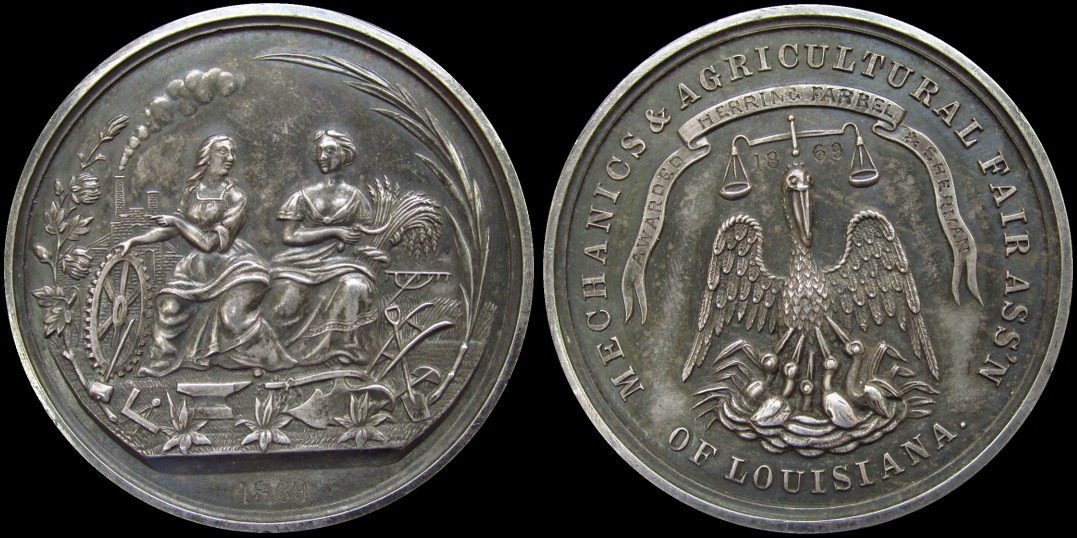
So called dollars have always been subject to interpretation, with Hibler and Kappens’s book(HK), being the main guiding force. Using HK as a guide, the majority of so called dollars are first and foremost, souvenirs and/or commemoratives of public events that occurred within the United States, especially the world's fairs. Some are also undated souvenirs of a public place or even commemoratives of famous persons. Confusion about inclusion often stems from the obvious problem of two sides, obverse and reverse, each with potentially different themes. There were some themes that were excluded from HK even if the other side was inclusive: a business advertisement/store card for instance. Other themes were what one might call "Neutral", an example being a "Good Luck" theme, not commemorative in nature, and thus not inclusive of a so called dollar, but not eliminating it as such either: Examples: HK433,HK457, HK474, HK707, HK895.
Size: The original 1963 book used the older size ranges of Size 21 to Size 28. The second edition of HK uses a range of 33mm to 45mm. This website uses a range of 32.6mm to 45.4mm. The biggest exceptions to this size rule are the monetary pieces in Part 3, section A, and also the much smaller gold dollar size examples. Also, with HK353-HK356, measuring 32.1 mm, the original authors of HK broke their 33mm rule. They obviously included it because it was an official US Mint commemorative of a worlds fair.
The following themes were usually excluded from HK even if the other side had a commemorative theme:
The following were generally "neutral" themes in HK, with the other side of the piece making it inclusive:
Holed or looped examples were almost always excluded, HK numbers 2 - 4 being the main exception due to it's historical significance. The 1st edition of HK states numbers "1 through 3" which is a misprint. So called dollars with holes are more accepted today, but generally speaking un-holed ones still usually have a larger following.
With regard to many of the categories not included in HK, a quote out of HK's introduction is important: "Some of these latter subjects, of course, have achieved an importance of their own and either have been treated by competent authorities or are worthy of such attention. In other cases, the material proved too abundant to permit proper consideration here."
Lastly, I guess to make things interesting, the authors of HK occasionally stretched or even broke their own rules, but there may have been good reasons. Most of those pieces are as follows:
HK2-4: Although only found holed, it was included because of it's high historical and numismatic importance. It is never found with an original attachment. Some of the earliest holed so called dollars were often sold with a single ribbon through the hole to add a little color or to tie on to something.
HK8: This is a foreign piece that commemorates the 2nd Crystal Palace in London built at Sydenham, not the first Crystal Palace in London at Hyde Park, and certainly not the Crystal Palace in New York, so the authors probably should not have let this one in. It is possible that it was distributed in the U.S. to advertise the London fair.
HK9-10: This event was held in Great Britain, but involved an American fighter with a large US following. The Thomas Sayers companion medal was not included in the 1st edition, but was in the 2nd edition.
HK35-36: A school medal on the reverse even though Hibler and Kappen's introduction specifically states "no school medals". The original authors appear to have made a number of rule exceptions when it came to the 1876 Philadelphia Expo.
HK114: This piece was not minted for the 1876 Centennial Exposition. Joe Levine's comment in his 39th Presidential Coin and Antique sale lot#618: "HK erroneously attributes this to the 1876 Centennial period. It is a good bit earlier"
HK149, HK296, HK297-298, HK538-HK541: All have advertising themes, but their historical significance seems to supersede the advertising. HK297-298 is an especially nicely executed and substantial medal, minted in silver and copper, unusual for an advertising piece. Click HERE for an unlisted example.
HK353-356: As stated above, this is the smallest so called dollar listed in HK, excluding the gold dollar pieces. Also included here are two sometimes overlooked mule varieties, HK-364, and (#71) on this website, both also very possibly U.S. Mint. Like HK353-356 they are also 32.1mm.
HK434: Advertising for a hotel, but was included anyway. From the 1915 Panama California Expo in San Diego.
HK465 and HK466: The Ford Exhibit at the 1933 Century of Progress Fair in Chicago was quite large.
HK476: How this holed one slipped into the book I have no idea. I have never seen it un-holed, although one may exist. Except for HK 2-4, the 1963 edition specifically states: "No holed or looped material unless struck plain also.".
HK689: Having a "$1.00" denomination, many collectors in the past have stated that this piece should have not been included.
HK725: I have a silver example (ClickHERE) of this medal being used as an award medal. I believe one in gold sold at one of the major auction houses recently that was also described as being an award medal.
HK733: Obvious advertising piece on one side, and partially so on the other side too. There are actually four or five other varieties of this piece, but the one listed in HK is the only one that goes beyond a strict advertisement by commemorating the "100th Anniversary Mechanics Fair Boston".
HK734-734b: Advertising for mines and a motel. Perhaps anything to do with mining is given a bit more leeway when it comes to so called dollar inclusion.
HK755: A trade association piece, but without a date. Sort of unique I guess.
HK832: Obvious silver dollar design, but no one seems to know for sure why it was made.
Section C Part 3: This is HK's "miscellaneous" section. Some of these pieces are difficult to classify. The Denver 1905 piece(HK876) seems perfectly legitimate. The Loyal League piece(HK874) and the KKK pieces(HK908, HK909) are both completely political/fraternal in nature and thus are a bit dubious, especially in light of the fact that almost no Masonic or Grand Army of the Republic pieces were included in the book. HK877-891 are all political in nature, but were included because of their association with Thomas Elder. The Swift pieces(HK905-907) are somewhat unique, and there are also a few unlisted pieces that have a similar theme(Click Here), and the reverses of HK483 and HK484 are also similar. Three military service medals were also included that are found un-holed and un-looped: HK-892, HK901, and HK-910. The United Nations piece(HK914-915) is an undated souvenir token and the only "spinner" in the book. The very last piece (HK916-917) is an undated patriotic/religious souvenir.
One last thing I guess I should say is the the authors of the second edition of HK put in a few new examples that did not always follow the above rules to the letter, but decided to place them in because of their obvious close similarity to pieces that were in the first edition of HK. Seasoned so called dollar collectors sometimes have different ideas about what to include or exclude. So to repeat my first statement: "So called dollars have always been subject to interpretation". Keep smiling, The End
© John Raymond 2025