NOTES:
Baker52S: My one example in white metal was from Stephen Alpert sale #55 lot#989. I also found one described as "silvered" but it was no doubt plated sometime after striking so was not entered.
Baker180: I did not tally this medal, but I probably should have.
BakerJ-195: The obverse of this piece is the same as BakerY-324. The reverse is the same as HK126. The obverse is also the same as the obverse of the piece listed directly below.
BakerJ-195(OBV)/Unlisted(REV): This piece has the same obverse as BakerJ-195 and BakerY-324. The reverse is the same as the obverse of #229(CLICK HERE)for image. Very similar in style to the reverse of Baker N-322. This is the only one that I have found. From Charles Kirtley sale #22 lot#125 with picture. 34mm
Baker264: Hiber and Kappen group this piece with other material from the Centennial Exposition held in Philadelphia in 1876; but Rulau/Fuld states that it was "struck 1861-62", and Joe Levine from his 39th PCAC sale lot#618 states: "HK erroneously attributes this to the 1876 Centennial period. It is a good bit earlier"
Baker320: Joe Levine from his 46th sale lot 871 states: "Called "excessively rare" by Rulau/Fuld and probably true for the silver example. White metal pieces should more properly be called scarce". The white metal examples are always holed even though my tally suggests that three examples were unholed. All three are from Presidential Coin and Antique sales where no mention was made of a hole, but I am sure this was an oversight in the descriptions as Joe Levine also states in one of his auctions that "all are holed". A silver example sold in Johnson & Jensen sale 26 lot #585 described as attractively toned AU. Another sold at Stacks March 2014 (IMAGE). There was also a copper shell of the obverse that sold at Presidential Coin and Antique Co. sale 11/15/97 lot#1114 that was described as "Uniface. XF; the very thin planchet a bit wavy".
BakerP-322: The only one of these that I located was the exact same piece described in Rulau/Fuld - Charles Kirtley sale #144 lot#AD139. This sale had a number of other neat Washington pieces.
BakerN-322: A large so called dollar(44.9mm). The four sales of this piece in bronze that I found were: Presidential Coin and Antique Company(PCAC) sale #40 Part 1 lot#168 AU, PCAC sale #56 lot#1154 Choice AU, Charles Kirtley sale #42 lot#698 Choice AU-55, and Rich Hartzog 8/13/83 lot#466 choice prooflike Unc.
BakerO-322: The same as BakerN-322 but with a different obverse. The only bronze example that I found was from Presidential Coin and Antique Company sale #40(Part l) lot#169.
BakerO322(OBV)/BakerE-452(REV): This appears to be a muling of the obverse of BakerO-322 and the reverse of BakerE-452. Only example found was from Presidential Coin and Antique Co. auction #34 Part 2 lot#818. It was described as: "BATTLE OF YORKTOWN MEDAL. 45mm. WM. XF. Obv: GEORGE WASHINGTON around small bust right within a wreath. Rx: GUNS CAPTURED AT YORKTOWN VA./OCT. 19, 1781/AT THE SURRENDER/OF/CORNWALLIS. PRESENTED BY/GENERAL GEO. WASHINGTON/TO CHATHAM ARTILLERY.". There was no picture.
BakerB-324: Listed in Baker in two metals, in HK second edition in four different metals. In any metal other than aluminum this medal appears to be very difficult to locate, more so than the R-6 rarity designations in the second edition of HK suggest. And in aluminum it is almost always holed, often with an attached hanger as pictured in Baker/Rulau page 155. Presidential Coin and Antique Company(PCAC) sale #56 lot#1148 sold one that was described as bronze. What appears to be a closely related medal was sold in Charles Kirtley sale #10 lot#722. It was described as "H&K UNLISTED. Similar to H&K 127 but with slightly different dies on both sides. Also unlisted by Baker. Rare. White Metal. CH AU-55". Unfortunately there was no picture.
BakerD-324: The same obverse as HK763 and BakerN-324. The sole bronze example that I found was from PCAC sale #61 lot#938. Described as Chocolate Bronze Unc 37.8mm.
BakerD-324(OBV)/Unlisted(REV): This is #270 in the unlisted so called dollar section of this website(IMAGE). This piece has the same obverse as BakerD-324, BakerN-324 and #265 in the unlisted section. The reverse is unlisted in both Baker and HK.
BakerM-324: Obviously quite rare. I was not able to locate this piece in any metal. Same reverse as the obverse of HK763 and BakerP324.
BakerM-324(REV)/Unlisted (REV): This piece has as it's obverse, the reverse of Baker M-324 and the obverse of BakerP324. It is combined with an unlisted "Souvenir" die (Bob Slawsky sale #58 lot#523). For image, (CLICK HERE)Have only found in white metal.
BakerM-324(OBV)/Unlisted (REV): This piece is listed in Rulau "United States Tokens 1700-1900" as NY-Du 6 in the New York trade tokens section. Same obverse as BakerM-324. Reverse advertises the "Grand Fair & Carnival The Young Men's Association Dunkirk, N.Y.". Sold in Charles Kirtley sale #42 lot#802 with picture. Have only seen in white metal. 37.7mm.
BakerN-324: BakerN-324 appears to me to be the same as BakerPA324. Both are listed on page 155 in Baker/Rulau. Same as HK763. Presidential Coin and Antique Company(PCAC )sold one in silver in their 72nd sale lot #343.
BakerN-324(OBV)/Unlisted(REV): This is #265 in the Unlisted So Called Dollars section (CLICK HERE). Same obverse as BakerN-324 and same reverse as HK763. This reverse can also be found combined with the obverse of Baker394.
BakerP324: I have seen this medal in both bronze and silver.
BakerU-324C: I only located two of these. One from Charles Kirtley sale #144 lot#AD137. The other was from Johnson & Jensen sale #10 lot#1536. Have only seen it in bronze.
BakerU-324E: The obverse of this piece is the same as the obverse of HK125-a. Obviously quite rare. (CLICK HERE) for one sold at Stacks a while back.
BakerV-324: Most common in white metal, and virtually all are holed. One in white metal showed up on ebay awhile back the was unholed. I have never found one in Gilt as described in Rulau/Fuld. The only bronze example that I located was from Johnson & Jensen auction #8 lot#279 where it was described as follows: "Much of the lettering is doubled as a result of "die draw" (metal flowed into, then out of die cavaties during striking - example of poor press-work). Projection at top intended for a loop. Very interesting specimen! VF-XF. Much luster...."
BakerY-324: In the second edition of HK as HK244a and HK244b. Same Washington bust side as BakerJ-195.
Baker341: I did not tally this medal. In hindsight I wish I had. Baker/Rulau gives it rarity ratings of 7-9.
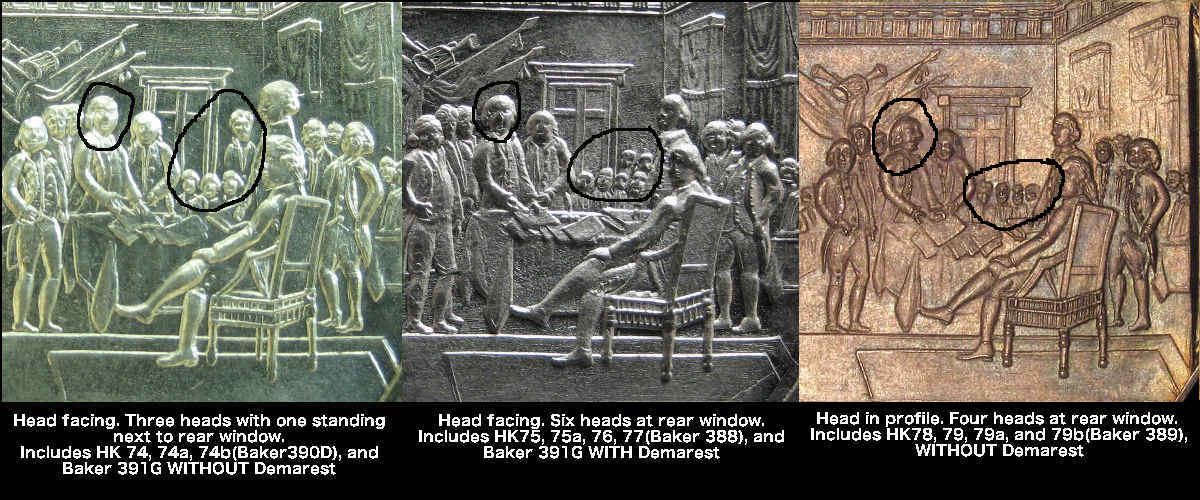
Baker388, Baker388A(HK75), Baker388B(HK76), HK77, HK75a: The reverse of this piece has "Demarest. SC." around below in small lettering. However the tally here includes all pieces both with "Demerest S.C.&qout;(HK75-HK77) and without "Demerest S.C.&qout;(HK78-HK79b). The old sales catalogs that I looked through to do the tally(catalogs prior to the year 2000) often did not distinguish between the two types due to confusion with the entries in the first edition of HK, and the left column in Baker/Rulau page 183. It is best to use the second edition of HK for identification. For further discussion about this confusion, including the reverse die varieties, read the note for Baker390D below. Also, due to their similarity, tallies for copper(Baker388) and bronze(HK75 and Baker388A) are combined together as are tallies for white metal(Baker388B) and pewter(HK77).
Baker388B(REV)/Baker391D(REV): This piece is the same as Baker391G but WITH "Demarest. SC." around below. For image in white metal, (CLICK HERE).
Baker389(HK79a), Baker389A(HK78), Baker389C, HK79: This piece is pictured in HK as HK78 - HK79b. The tallies for this piece are included above with Baker388, Baker388A(HK75), Baker388B(HK76), HK77, and HK75a. And read below about Baker389B.
Baker389B: Baker389 is listed in Baker as existing in Brass(Baker389B), but not in HK. Looking through old catalogs, I am not completely sure if I found HK389 in brass or not. If I did, I may have tallied it with Baker388/Baker388A in copper/bronze. If it does in fact exist, it is quite rare, perhaps even rarer than those in silver.
Baker390: Until recently(2019), I thought that maybe this piece did not exist. However in the November 2019 Stacks auction, one sold in white metal(lot #20577). It is the die combination of the obverse of Baker388/Baker389 combined with the reverse of HK74. The Baker description of this piece as being the same as HK74 is in error. For further discussion, read below about Baker390 and Baker390D.
Baker 390 and Baker390D: The two entries in Baker for Baker390 and Baker390D(which is very similar to HK74 and often used synonymously) are so confused and in error that it would be best to just cross them out and use the second edition(not the first edition) of HK instead. In fact it is best to use the second edition of HK in place of the entire left column of Baker/Rulau page 183. To begin with, Baker/Rulau states that Baker390 is the same as Hibler-Kappen 74. This is wrong. I am sure the authors meant for the Hibler-Kappen 74 designation to go with Baker390D instead of Baker390, but as it turns out, that would not have been entirely correct either. Baker390D is described in Baker/Rulau as being a combination of the Trumbull painting die of Baker389(no "Demerest S.C." around below) with what is the same reverse as HK74. But as it turns out, there are actually TWO different Trumbull painting dies WITHOUT "Demerest S.C.", one used for HK74, the other used with HK78/79(Baker389), and it appears not interchangeably. For a comparison of all three dies, Click Here. All three are also shown in the second edition of HK(obverses of HK74, HK75, and HK78). There are many minor differences between the two WITHOUT "Demerest S.C." dies, but perhaps the most obvious is a man standing in the distance just to the right of the right window(actually a doorway in the original painting by Trumbull) of HK74. This man is missing on Baker389. Thus Baker390D, although very similar to HK74, probably also does not exist. As stated earlier, because of their similarity, HK74 and Baker390D are often used synonymously, and so both are tallied together.
Baker391G: The reverse of this piece(Trumbull's Declaration scene) uses the same reverse "No Demerest S.C." die as HK74. For a discussion of all three Trumbull Declaration scene dies, read "Baker390 and Baker390D" above. The single one of these in silver that I located was from the 4/28/81 NASCA sale lot 4044. For an image of Baker391G in white metal, (CLICK HERE). For the variety WITH "Demerest S.C.", read about "Baker388B(REV)/Baker391D(REV)" above.
Baker392: Nice rendition of Washington in uniform in good relief and sharp detail. Is also found as the obverse of Baker397.
BakerA393: I only found two examples. One was in PCAC auction #48 lot#342 with a poor picture and was described as "A Beautiful, but obscure medal by the St. Louis diesinker Steubenrauch". I did not record where I found the other. Found on page 184 in Baker/Rulau.
Baker394: Baker/Rulau describes this medal as being the same as Hibler-Kappen 42-45, which matches the medal shown in the second edition of HK. However the first edition of HK designates a different reverse. For consistency it would be best if everyone disregards the first edition entry and use the second edition. For years I think that most everyone thought that the HK first edition entry for HK42-45 may have been a misprint due to the fact that that particular die combination was so difficult if not impossible to find. But read below about Baker394B(OBV)/Baker392A(REV). The two silver pieces(HK42 second edition) that I located were Stacks sale 5/6/92 lot #138, and PCAC sale #68 lot#109. The sole piece described as being Copper Nickel was from PCAC sale #58 lot#193 where it was described as being "unlisted as such". It is possible that the two pieces I found that were described as brass could in fact have been gilt.
Baker394B(OBV)/Baker392A(REV): This piece IS the same as HK43 as described in the FIRST edition of HK. Some auction catalogs state that the first edition of Hibler/Kappen's book was incorrect in it's description of HK42-HK45(read the above note about Baker394). In fact, at least as far as HK43(in Copper/Bronze), Hibler/Kappen's first edition description is correct. Joe Levine of PCAC actually sold an HK43 in his sale #25 lot #1314 exactly as described in Hibler/Kappen(It appears that he forgot he sold it). Paul Van Sant also sold an HK43 in his August 1997 fixed price list. A third was probably(the description was not elaborated on to be absolutely sure) sold by Charles Kirtley #160 lot#MO55. Note that all three of these HK43s were looped(possibly clamped on loops). Also, possibly two out of three, or even all three could in fact be the exact same piece.
Baker394C(OBV)/Unlisted(REV): This piece has the same obverse as Baker394 combined with a different reverse. #264 in the Unlisted section. (CLICK HERE) for image. Have only seen in white metal. This reverse can also be found combined with the obverse of BakerN-324.
Baker394(OBV)/Blank Reverse: From Presidential Coin and Antique Company(PCAC) sale #27(Part l) lot#309 where it was described as "Obverse die trial of Baker 394 in tin. Nice Unc." With photo.
Baker397: Two of the silver pieces recorded here were from the Stacks Gilbert Steinberg sale held 5/6/92 lot#139 and lot#140. The other silver piece was from PCAC sale #73 lot#213. The sole gilt example was from PCAC sale 11/15/97 lot#906, described as "Gilt, as such, unlisted. Baker 397. Holed AU".
Baker398: I recorded three of these, all holed. PCAC sale #44(6/25/88) lot#493(no photo); PCAC sale #47 lot#278(with photo); and Stacks 5/6/92 sale lot#141(with photo).
Baker405: The silver plated piece recorded here was from PCAC sale #56 lot#1136. Tony Swicer may have also had a silver plated piece in his 1992 sale.
Baker406: The only piece that I found that was described as being made of brass was from Bob Slawsky sale #39 lot#558. The only two pieces that I found that were described as gold plate were from Johnson and Jensen sale #10 lot#1281, and Johnson & Jensen sale #18 lot 512.
Baker409: Obviously far more common in White metal. The sole silver example that I found was from the Stacks Gilbert Steinberg sale held 5/6/92, lot#145. I did dot find any in bronze.
Baker410(OBV): This piece is the same as the obverse of Baker410, but with a blank reverse. I believe that Baker410 always comes looped as shown in Baker/Rulau, but the uniface piece is never looped. For some reason the picture in Rulau/Fuld is oval shaped, but the actual piece is round. (CLICK HERE) for image of the un-looped version in the Unlisted So Called Dollar section. I did not keep a tally of Baker410 as shown in Baker/Rulau, but I did tally the uniface piece and found five examples, all brass. I recorded where I found three of them. They are as follows: Steven Alpert sale #55 Lot#927 described as "unlisted uniface brass strike of obverse, 39mm, no loop, toned BU, nice.". Kurt Krueger sale #53 lot#3616 described as "Anniversary uniface medal. Brass EF-45" with small photo. PCAC sale #44(6/25/88) lot#206 described as "41mm. Brass" and "not issued with the loop that usually attends the fully struck token." At a show a while back I saw a Baker410(the double sided version) in a slab without a loop, but there was no way to tell if a loop had been removed. It probably had been.
Baker415A: One of my tallies in bronze was from Johnson & Jensen sale #10 lot#1298. Described as being "34.3mm" and having a "Red-brown patina. AU"
BakerC-415: An attractive piece by George Lovett, and obviously quite rare. I found no examples.
BakerF421: It may be that the gilt and brass pieces are one and the same.
Baker425: I found three pieces in silver. I recorded where I found two of the three. One was from Stacks 5/6/92 lot#148, with photo. The other was Charles Kirtley sale of 8/12/86 lot#1078 with photo.
Baker428: This piece has a common reverse with four other pieces, all of which were souvenirs for visitors to the 1876 exposition held in Philadelphia - in English, German, French, and for Catholics(IMAGES). The sole silver piece that I found of Baker428 was from the Gilbert Steinberg May 6,1992 Stacks sale, lot#152 with photo.
Baker429: I found ten examples of this piece, all holed. Seven were graded AU. None were graded Unc. All were in white metal.
Baker433: This piece is a muling of the obverse of Baker394 with the reverse of HK60/61. I found only two of these, both in white metal. One was in Paul Van Sant's August 1997 sale of Neil Conner's collection where it was described as AU55. The other was PCAC sale #56 lot#1137 where it was described as "Prooflike Unc.", and was misdescribed as HK61. Obviously this piece is quite rare in all metals.
Baker448: Although the first obverse pieces can most commonly be found in white metal, I have yet to find any white metal second obverse pieces.
Baker449 S: Of the ten sales tallied, it appears that most were different pieces. The ten sales were as follows:1)Johnson & Jensen 9/16/79 lot 591. Part of a boxed set of three medals including one in silver. Described as obverse having slight nicks and reverse perfect. Was not graded specifically, but all three pieces were graded overall VF-AU. No photo 2)PCAC 6/25/88 lot 76. Described as choice about uncirculated with uneven blue & rose toning. No photo 3)PCAC 12/2/89 lot 280. Described as choice uncirculated with attractive pale gold and turquoise toning, and the choicest of the two specimens owned by Paul Magriel. No photo. This piece sold once again at the 12/8/90 PCAC sale lot 251, with photo. 4)PCAC 6/25/94 lot 146. Described as Choice uncirculated with attractively toned and proof surfaces. It was originally bought from Tony Swicer who noted that it was Ex-Dreyfuss, #5449. With photo. 5)Dick Grinolds 6/9/98 lot 1086. Described as xf+++-au with a small rim bump at 9:00 obverse. With photo. 6)PCAC 11/13/99 lot 339. Described as Choice deeply toned about uncirculated. With photo. This same piece also sold in PCAC 12/1/01 lot 471. This latter sale was after year 2000 so was not added into population numbers. 7)Bob Slawsky 12/1/99 lot 927. Described as Proof with light orange toning. With photo that appears to show some hairlines on the obverse field. 8) NASCA 6/6/78 lot 3810. Described as AU with beautiful iridescent toning. 9) NASCA 4/28/81 lot 1764. Described as Prooflike Choice AU with light golden toning, violet reverse, with prooflike fields and frosty devices and rims, edge bruise 1:00, minor contact marks.
Baker449 BZ: Original bronze pieces have a chocolate brown appearance. Modern restrikes have a lighter yellow bronze matte surface. Julian describes this piece as existing in aluminum, but I have never seen or heard of one in that metal.
BakerE-452: The diameter of this medal at 45mm(Baker/Rulau page 197) is at the very upper limit of accepted size for a so called dollar. A more accurate measurement of a white metal example from Presidential Coin and Antique Company(PCAC) sale #69 lot#1279 was described as 44.8mm; and a bronze example was listed at 44.7mm in Johnson & Jensen sale #15/16 lot#254. The gilt example is from Kurt Kruger sale #142 lot#2787, and was possibly plated sometime after striking.
Baker453: This piece is described in Rulau/Fuld as being 32mm in diameter, but in every auction catalog where I have found this piece, it is always described as being 33mm in diameter. The sole silver example that I found was from PCAC sale #44(6/25/88) lot#077 where it was described as "Deeply toned blue over mirror fields".
Baker454: I did not tally this medal because I thought it was too small for inclusion as a so called dollar. It is listed in Baker/Rulau at 32mm. It's actual diameter is 33 to 33.2mm
Baker454(OBV)/Baker453(REV): This is a mule of the obverse of Baker 454 with the reverse of Baker453. From Stephen Alpert sale #24 lot #2349. It was described as being "33mm, prooflike AU". Measurements in Baker/Rulau for Baker453 and Baker454 are 32mm. But I believe they may in fact be just over 33mm, possibly 33.2mm to be exact.
BakerR-456: I found six of these in old auction catalogs that were described as copper. In most of the auction catalog descriptions they were specifically described as copper and unlisted as such to distinguish them from the HK134 in bronze; and in Paul Koppenhaver sale March 26, 1976 lot #446 it was described as "like HK134 but Copper with a Reeded Border" The second edition of HK lists it in copper plate as HK135a, but I have never found one as such.
Baker457: This piece is 35mm in diameter, not 33mm as listed in Rulau/Fuld. It has the same obverse as BakerA1810, and the same reverse as Baker458.
Baker458: This piece is 35mm in diameter, not 33mm as listed in Rulau/Fuld. Same reverse as Baker457.
Baker459: This medal has the same obverse as HK145. Looking through the catalogs that I looked through, I did not find any in copper or bronze, but did locate one in silver proof from Abner Kreisberg sale 10/31/66 lot#71. One double thick white metal piece was described as follows by Joe Levine in his PCAC sale #45 lot#560: "Baker 459B. 44.9mm. WM. XF/AU. Charles Cushing Wright and Anthony C. Paquet,Sc. Obv: Very high relief Houdon bust by Wright, dean of American 19th Century engravers. Rx: Commemorative date and laurel. Published by Warner & Brother, Philadelphia. Double thick, 4.8mm at rim, 6.5mm at center. Some darkening in the fields.".
Baker462: I found none in copper, and all white metal pieces found were holed.
Baker610, Baker611, BakerM-611, Baker 612, Baker 613: I did not tally any of these, but in hindsight I wish that I had.
Baker777: Page 291 in Baker/Rulau. I found three of these. The first was PCAC sale #45 lot#752 where it was described as "35mm. Nickel plated. XF". The second was from Bob Slawsky sale #45 lot#283. It was described as "silver, 35mm, XF." The third was from Charles Kirtly sale 169 lot K050 35mm VF-30 silver plated copper. I did not find one in gilt as listed in Baker/Rulau. This piece is located within the store card section of Baker/Rulau, and so called dollar collectors usually exclude store cards(advertising tokens/medals), but in my view this piece is more of a commemorative than a store card, commemorating George Washington's birthday and the Marathon County Homecoming. This piece is located within the Unlisted so called dollar section of this web site(CLICK HERE) for image.
Baker1004: I did not tally this piece, but in hindsight I wish I had. It is probably hard to come by.
Baker1810: The two pieces in bronze that I found were from PCAC sale #53 lot#1280 where it was described as "35mm. Chocolate Bronze. George Morgan, Sc. Unc"; and Johnson & Jensen sale#10 lot#1421 where both a white metal and bronze piece were sold as one lot and described as "Flawless unc!". The white metal pieces are usually found holed, but can be found unholed.
BakerA1810: This piece has the same obverse as Baker457. The three bronze pieces that I found were from Charles Kirtley sale #42 lot#800 "Choice Unc-63"; PCAC sale #64 lot#1744 "Choice unc"; and Charles Kirtley sale #161 lot#B073 "Unc". Located within the Unlisted so called dollar section of this web site(IMAGE)
Unlisted Taking Oath Evacuation Centennial: Description as follows: Obv: Four men standing, Washington taking oath. Thirteen small stars around. "George Washington Taking The Oath As First President Of The United States" around outside. "April 30, 1789" around above. "In Federal Hall Wall St. N.Y." below. Rv: Scene with men and sailing ships. Man at top of flagpole changing flags. "1783-Centennial-1883" around above. "Celebration Of The Evacuation Of New York" around below. "John Van Arsdale Removed The British Flag And Nailed The Emblem Of Freedom In Its Place" in three arcs around above. 35.7mm, Have only seen in white metal. #94 within the unlisted so called dollar section of this website.(IMAGE)
Unlisted Washington Hawaii: Description is as follows: Obv: Bust of Washington three quarters left. "George Washington" around above. "1789 1797" to the left and right of bust. Rv: Coat of arms with standing figures to the left and right of square shield. Wings below. "Hawaii 50th State August 21 1959" in four lines above shield with "Hawaii" in larger letters around above. 39mm, Have only seen in bronze/copper. I am guessing that this piece was made at the same time that Hawaii was admitted as a state.
Unlisted Little Red School House BZ and WM: Description is as follows: Obv: Crossing scene. "Golden Jubilee Washington Crossing The Delaware" around above in three curved lines. "Aug. 23-28 1897. Reading Pa" Rv: School house with large flag. "God Our Country And Our Order" around in larger lettering. "The Little Red School House" around in smaller lettering. "The Bulwark Of Liberty" in two lines below school house. Rare in white metal or bronze and holed maybe half the time. 37.8mm
Unlisted Washington Liberty Bell: Description is as follows: Obv: Bust of Washington left on shield within closed wreath. Scrolls to the left and right. "Constitution Centennial" around above. "Phila Pa Sept 15-17" around below. "1787 1887" on scrolls split to the left and right. Rv: Liberty Bell within thick wreath border. "Liberty Bell" around to the left and right of wreath. Obverse and reverse pictured in Charles Kirtley sale #42 lot#787. Another sold in PCAC sale #44(6/25/88) lot#669(no picture). In both sales this piece was described as being 33mm white metal. Both were holed. The obverse design of this piece is the same as the obverse of Douglas44, but with different inscriptions.
Unlisted Washington Monument/GAR: This is #229 with the unlisted so called dollar section of this website(IMAGE). Not in Baker/Rulau. The monument side of this piece is the same as the reverse of "BakerJ-195(OBV)/Unlisted(REV)" listed near the top of this page(CLICK HERE)
Douglas10: Virtually all of these are holed. Occasionally they are found with attachments. Charles Kirtley sale #158 lot#P004 was described as having a Red/White/Blue ribbon; Johnson & Jensen 5/20/79 sale lot#447 was described as having an attached eagle pinbar.
Douglas11: Appears to be somewhat less common than Douglas10, and can more often be found unholed.
Douglas13: Two of the five bronze pieces that I found were as follows: Charles Kirtley #16 lot#500 "Bronze. Prooflike Unc-60 unholed"; and Charles Kirtley #42 lot#705 "Bronze. Choice UNC-63 with prooflike fields, and virtually flawless surfaces. Breathtaking.". White metal pieces can occasionally be found with attachments. Johnson & Jensen sale#10 lot#1433 was described as "Hung from red, white, blue ribbon & header". I found no gilt pieces.
Douglas14A: Two of the five I found in bronze were: PCAC #47 lot#1640 described as unholed Unc; and Johnson & Jensen #10 lot#1435 described as "Chocolate brown patina. Flawless! Unc"
Douglas14U: Could find no examples, so obviously quite rare.
Douglas18: In Charles Kirtley sale #42 there were two unholed pieces, with photos (lot#752 and lot#848). In Johnson & Jensen sale #15/16, lot#1844 was described as being "Hung from red-white-blue ribbon & brass header".
Douglas19: There is a not so good photo of this piece in Charles Kirtley sale #42 lot#753. All I found were holed.
Douglas20M: I cannot tell the difference between Douglas20 and Douglas20M as described in Rulau/Fuld. The reverses of Douglas18 and Douglas20 look the same to me.(???) If anyone can tell me what the difference is, let me know.
Douglas21 and 21A: I lumped these two together as the only difference is the edge. Usually holed, but occasionally unholed.
Douglas37: The reverse of this piece is more commonly found muled to an obverse showing the bearded bust of Bartholdi within an oval. Douglas37 with the Washington obverse is considerably rarer.
Douglas41: I did not tally this piece, but I should have as it measures less than 45mm. PCAC sale #78 described this piece as being 44.5 mm in diameter, 44.1 grams.
Douglas42C: With blank reverse. I found no examples.
Douglas42(OBV)/Unlisted(REV): This piece has the same obverse as Douglas42 combined with a reverse that was described as follows in Charles Kirtley sale #36 lot#598: "Rev: WASHINGTON D.C. / (capitol building)". This is the only one of these I have located. It was made of white metal and was holed. 34mm. There was no picture.
Douglas43: One piece from Johnson & Jensen sale #23 lot#648 was described as having a "Brass spread eagle on crossed cannon pinback header". It appears that about half of the white metal pieces can be found unholed. Much rarer in bronze.
Douglas44: All appear to be holed. Two pieces found were made of lead: PCAC sale #44(6/25/88) lot#715, described as being "Lead"....that "was once bronzed"; and Johnson & Jensen sale #10 lot#1482 was described as being made of lead in "fair" condition. Also, a white metal piece in PCAC sale #46 lot#911 was described as having a "maroon and yellow ribbon, a brass top bar".
Douglas47: Occasionally one of these pieces will turn up without a hole, but the vast majority are holed. An unholed example showed up on ebay a few years ago.
Douglas49A: Occasionally the white metal pieces can be found with a red, white & blue ribbon with a brass top pinbar.
Douglas50: Appears to be rarer in white metal than bronze. The sole silver example found is from Stacks sale held 5/6/92 lot#189 where it was described as "Silver, unlisted in this metal. Select prooflike Uncirculated, toned. Plain edge. Spot of die rust in right reverse field". None in any metal found holed.
RulauNY-DU 6 : This is exactly the same piece as Rulau NY-DU 6, Young Mens Association Dunkirk, N.Y. It has the same obverse as Baker 50D and Baker M-324. There is a picture of both the obverse and reverse of this piece in Charles Kirtley sale #42 lot#802
© John Raymond 2016