The term "so-called dollar" has been used by coin collectors since the early 1900s to describe a broad range of commemorative medals and souvenir tokens that are similar in size to a silver dollar. Most commemorate American historical events of national or local significance such as world's fairs, city and state anniversary celebrations, statue dedications, famous American battles, completion of public works projects, and others. They usually measure between 33 and 45 millimeters in diameter, with most collectors sticking to those made prior to the early 1960s or so, partly because that's when the most important book on the subject was written(read below). Military and various award medals are generally not included. Their popularity stems from their historical significance, their varied and sometimes attractive designs, their rarity, and their size. Dollar or crown size coins have always been popular with collectors, so the interest in medals and tokens of similar size seems to have been a natural progression.
There are also other groups of medals and tokens that are classified as so-called dollars. One group, with no size limitations, are the "monetary" so called dollars. They were issued during the gold standard/silver controversy that was a divisive political issue during the late 1800s. Another group are the many rare dollar sized medals issued in the early 1900s by the famous coin dealer, Thomas Elder.
For decades the most important book on the subject has been Harold E. Hibler and Charles V. Kappen's book of So-Called Dollars("HK" for short). There is an older 1st edition that was published in 1963, and a better more recent 2008 updated 2nd edition. There was also a smaller booklet, now of only historical interest, published in 1953(reprinted in 1984) by Richard Kenney.
More recently two excellent books covering "Exposition" so called dollars have been authored by Jeff Shevlin and Bill Hyder: "So Called Dollars From The West Coast Expositions" printed in 2018, and their newest book "So-Called Dollars Volume 1: United States Expositions" printed just this year. Their newest 2023 publication (CLICK HERE for info) covers ALL of the expositions coast to coast, not just the west coast expos. The book has a considerable number of so called dollars that were not listed in the 1962 or 2007 editions of "HK", and some not on this website, all with full color images. There are many new compositions and other info never published anywhere before - truly cutting edge and a fun historical read.
What about values? Values are hard to pin down sometimes, and of course markets change. For a so called dollar to be valuable, one of my basic thoughts is that it should have at least two things going for it, whatever those two things are: Artistry, Rarity, Condition, Historical significance, US Mint, Intrinsic value, Worlds fair, Widespread familiarity - strangely sometimes the opposite of rarity, Or whatever else might seem meaningful. For instance, if it is rare, but nothing else, it might not attract much interest because rarity is often a common characteristic of tokens and medals. But if it is rare along with other attributes, then it will probably attract more interest. One problem with so called dollar values is that many of the more rare and desirable so called dollars rarely come up for sale, so without any price history, what's it worth? It is often hard to know, but usually there are past sales histories of other similar pieces. Tally comparisons such as on this website and at NGC's census can be helpful. Sometimes it is just a gut feeling that you have, or obviously it's something you want more than the other person. So called dollars are less expensive than coins of the same rarity and condition. The most common so called dollar is HK-154. It might have a similar rarity to a 1916-D dime.
What about counterfeits? The term "restrike", or "copy" might be more appropriate descriptions for tokens and medals. Restrikes/copies of so called dollars are not many, and those that do exist are usually well documented. Counterfeiters tend to go after coins that have both higher values and high mintages. Such is not the case with so called dollars. Also, so called dollars might be even harder to duplicate than coins due to their varied and often unique compositions and/or platings. Even a small number of high quality copies would probably quickly raise suspicions.
Lastly, why was the 1962 edition of HK missing so many pieces? There are at least two reasons. One is that the amount of information available to the authors was quite limited compared to today. To find what I found, I was able to go through piles of old sales catalogs that did not exist in 1962, and of course since around the year 2000 the internet has changed everything. Another reason is what the authors state in their introduction: "all material described in this work has been seen and handled by the authors". You can tell that this was true by how accurate the descriptions are, even for those without images. The authors had a good overall sense of tokens and medals, and their decisions for inclusion were probably as good as anyone could have done, but they obviously sacrificed completeness for the sake of accuracy. One example comparing then to now, is at the bottom left of page 121 of the second edition of HK(top right page 99 first edition). The authors describe a medal that they had read about, but had not seen. It is a Cleveland Centennial medal, (#182 on this website). Over the years I have located over twenty sales in catalogs and on the internet, in four different metal compositions. Almost all appear to be holed which may have precluded it from inclusion being that the original authors excluded holed medals, but the silver ones are found un-holed.
A FEW EXAMPLES OF SO CALLED DOLLARS
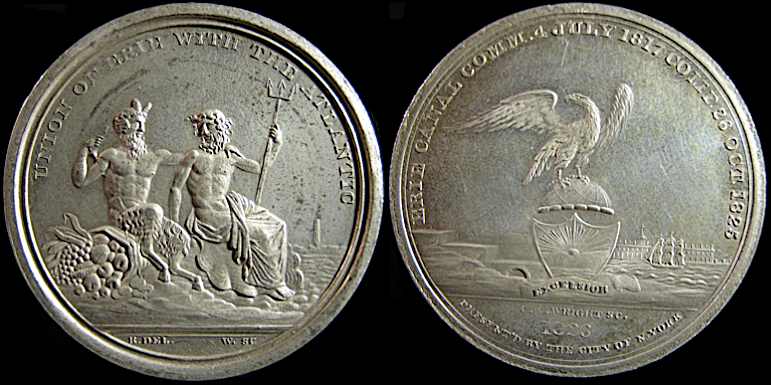
This medal is the oldest and first so called dollar listed in "HK". It commemorates the completion of the Erie canal in 1825, and was given to guests and dignitaries at the official opening. 44 millimeters in diameter.
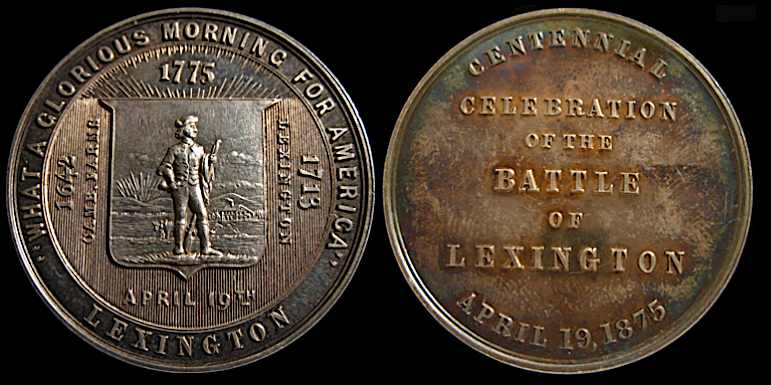
Minted by the US mint in 1875 to commemorate the 100th anniversary of the battle of Lexington. 38.5 millimeters in diameter.
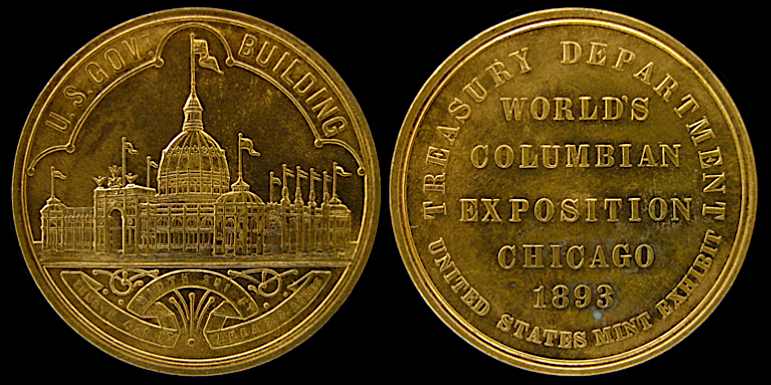
This was the official souvenir medal minted on the fair grounds at the World Columbian Exposition held in Chicago in 1893. The US mint was not allowed to mint US coins outside of the US mints, but commemorative medals such as this could be. It is the most common so called dollar. 38 millimeters in diameter.
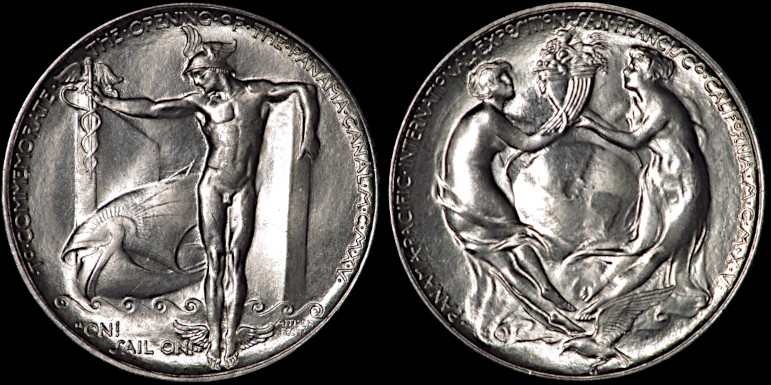
Another official souvenir medal minted on the fair grounds by the US mint. This one at the Panama Pacific International Exposition held in San Francisco in 1915. It is often considered to be one of the most attractive so called dollars. 38 mm in diameter.
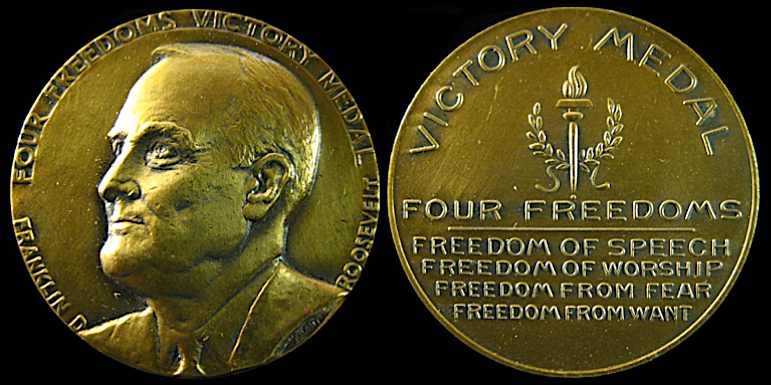
A 1945 victory medal issued at the end of World war II commemorating the end of the war. 38 millimeters in diameter.
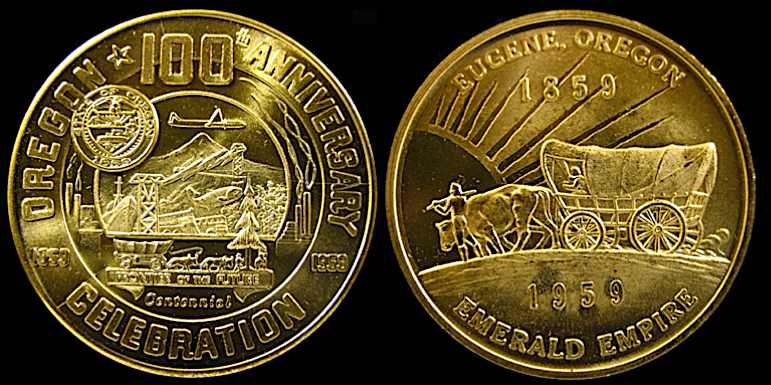
Issued in 1959 at the 100th anniversary of Oregon Statehood. 34 millimeters in diameter.
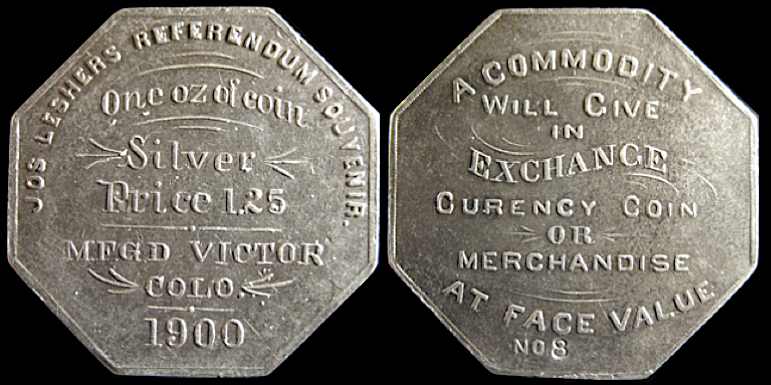
A Lesher Dollar. This is a "monetary" so called dollar privately issued in 1900 by Colorado silver miner Joseph Lesher. He was an advocate of the free coinage of silver. Lesher dollars are some of the more expensive so called dollars.